
Parent’s Guide
Online Quran Classes for Children: A Parent’s Guide
A good Quran class for a child should build accurate reading, confidence and consistency without turning every lesson into pressure. The teacher, lesson length, practice routine and parent role all matter.
Choose live teaching with a teacher experienced with children, begin from the child’s actual reading level, keep practice realistic, introduce Tajweed gradually and make sure parents receive enough feedback to understand progress.
Begin with the child’s real level, not the number on their birthday
Two children of the same age can need completely different Quran lessons. One may already read Arabic comfortably, another may still be learning individual letters, while a third may have memorized several short surahs by listening but cannot yet decode a new line from the mushaf.
That is why the first useful question is not simply “How old is the child?” It is “What can this child actually read independently today?”
A short assessment can look at letter recognition, short vowels, joined letters, unfamiliar words, fluency and recurring pronunciation problems. This prevents a child from being placed in material that is frustratingly advanced or so easy that attention disappears.

Age-appropriate teaching should still be serious teaching
Making a lesson suitable for children does not mean removing substance from it. Children can learn correct articulation, basic Tajweed, careful reading and memorization. The difference is in how those skills are presented.
Al-Azhar’s recently introduced simplified Tajweed curriculum for primary pupils is built around gradual learning and practical application suited to younger students. That is a useful model for parents to remember: serious knowledge can be presented in smaller, clearer steps.
A child usually benefits more from hearing one sound, trying it, being corrected and repeating it in a real Quranic word than from memorizing a page of terminology before understanding what the words describe.
Al-Azhar: age-appropriate practical Tajweed • Dar al-Ifta: parents and children’s education • Tajweed background

The teacher needs to hear the child, not only present information
Recorded lessons can demonstrate Arabic letters and Tajweed rules, but they cannot tell a child that the sound they just produced came from the wrong articulation point.
Live correction matters because young learners often repeat what feels familiar. If a pronunciation has been wrong for months, it may sound completely normal to the child.
A good teacher does not interrupt every second, but notices the mistakes that matter, isolates them and gives the child another chance to produce the sound correctly. The lesson becomes a cycle of reading, listening, correction and repetition.
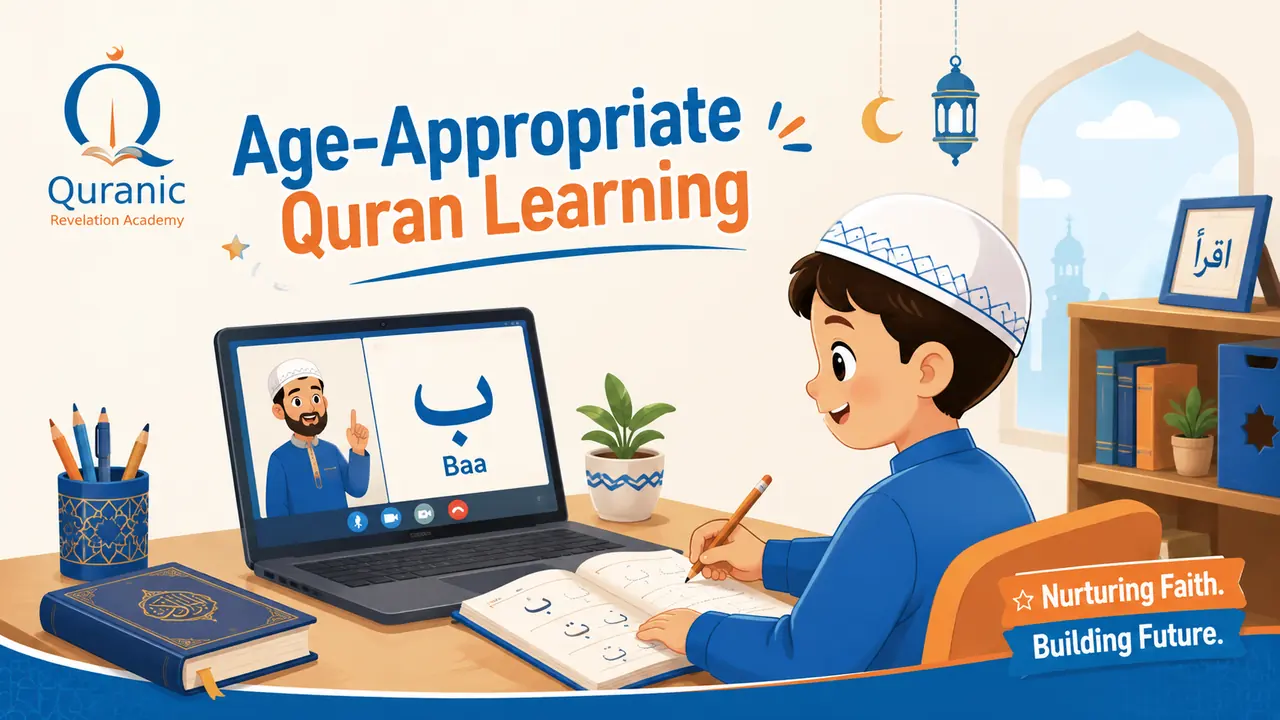
Short focused lessons can outperform long exhausted lessons
More minutes do not automatically mean more learning. A younger child who is mentally present for twenty-five focused minutes may learn more than one who spends the final half of a long session looking away from the screen.
Lesson length should therefore depend on age, concentration, reading level and teaching style. The useful question is not only how long the class lasts, but how much of that time the child is genuinely engaged.
For some learners, several shorter contacts with the Quran during the week are easier to sustain than one very long lesson followed by six days with no review.

Reading and memorization are different skills
A child can recite a familiar surah beautifully from memory and still struggle to read an unfamiliar word. That is not unusual. Memorization and reading support each other, but they are not the same skill.
Parents should know which ability the current lesson is developing. If the focus is memorization, independent reading should not quietly disappear. If the focus is reading, memorization can still continue in a manageable amount.
The strongest long-term program usually makes both skills visible: the child can preserve what has been memorized while gradually becoming less dependent on hearing every new passage first.

Parents should support the system without becoming the second teacher
Parents have an important role in education, but that role does not require correcting every technical Tajweed detail at home. If a parent is unsure about a pronunciation, it is often better to note the word and ask the teacher than to reinforce an uncertain correction.
A parent can protect the lesson time, prepare the device and mushaf, remind the child about a small practice assignment and ask what was learned. Those simple actions make the class feel like an important part of family life.
Children also notice whether the adults around them value Quran learning themselves. When the Quran is treated only as an obligation imposed on the child, that message is heard very quickly.
Progress should be visible in quality, not just page numbers
Parents naturally like measurable progress, so page counts and memorized surahs are tempting indicators. They tell only part of the story.
Look for fewer repeated pronunciation mistakes, quicker recognition of letters, less guessing at unfamiliar words, better memory of corrections from the previous lesson and greater comfort reading aloud.
A child who reads less material but is steadily becoming more accurate may be progressing far better than one who races through pages while repeating the same errors.
A simple weekly structure for a young learner
- Use the live class for reading, listening and direct correction.
- Review the exact corrected lines for five to ten minutes the following day.
- Practise one pronunciation or Tajweed target in the middle of the week.
- Read the assigned section once before the next class.
- Keep a short note of words that still feel difficult.
- Ask the teacher periodically what has improved and what comes next.
Common mistakes parents can avoid
- Choosing a level only by age.
- Measuring every success by the number of pages completed.
- Making practice so long that the child begins to resist it.
- Correcting pronunciation at home when the parent is unsure of the correct sound.
- Changing teachers repeatedly before giving a reasonable teaching plan time to work.
- Ignoring persistent anxiety or frustration around reading aloud.
Frequently asked questions
What age should a child begin online Quran classes?
There is no universal age. A child can begin when they can interact with the teacher and follow a short structured lesson. Very young learners may begin with letters, sounds and short surahs.
Should children learn Tajweed from the beginning?
Correct pronunciation should matter from the beginning, while detailed Tajweed terminology can be introduced gradually as the child’s reading develops.
Should reading come before memorization?
They can develop together. The important point is to recognize that memorizing a passage and independently reading a new passage are different skills.
How often should a child practise?
Short regular practice is usually more sustainable than occasional long sessions. The appropriate amount depends on age, level and attention.
What if my child does not connect with the teacher?
First identify whether the problem is ordinary resistance to correction or a genuine teaching mismatch. If communication and engagement consistently fail, another teacher may be more suitable.
Sources and further reading
Let your child try a live Quran lesson
A trial lesson allows the teacher to hear your child’s current reading and gives you a chance to see the teaching style before committing.



Comments
One response to “Online Quran Classes for Children: A Parent’s Guide”
[…] to Learn Quran Online: A Practical Beginner’s Roadmap Online Quran Classes for Children: A Parent’s Guide How to Build a Consistent Daily Quran […]