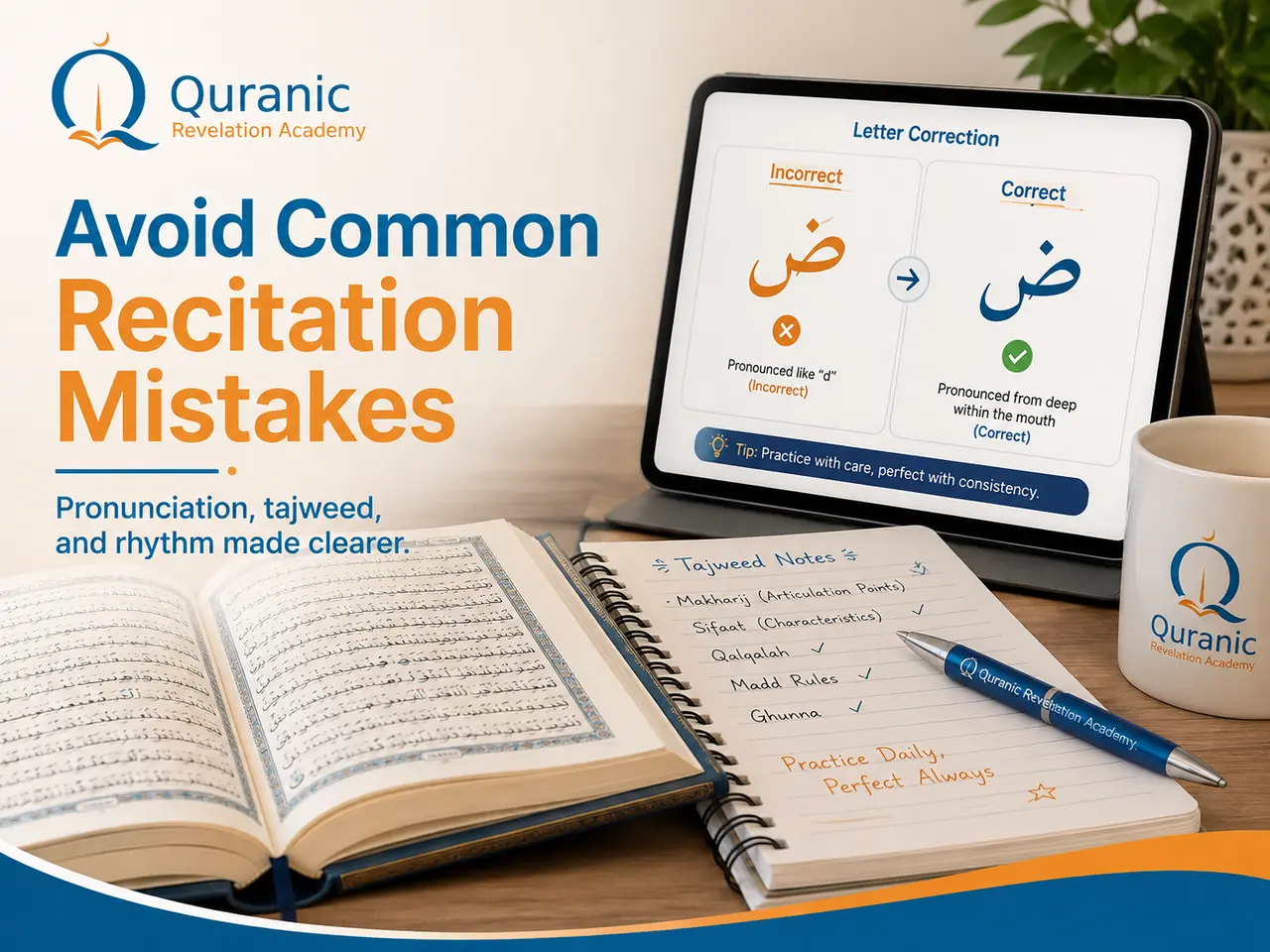
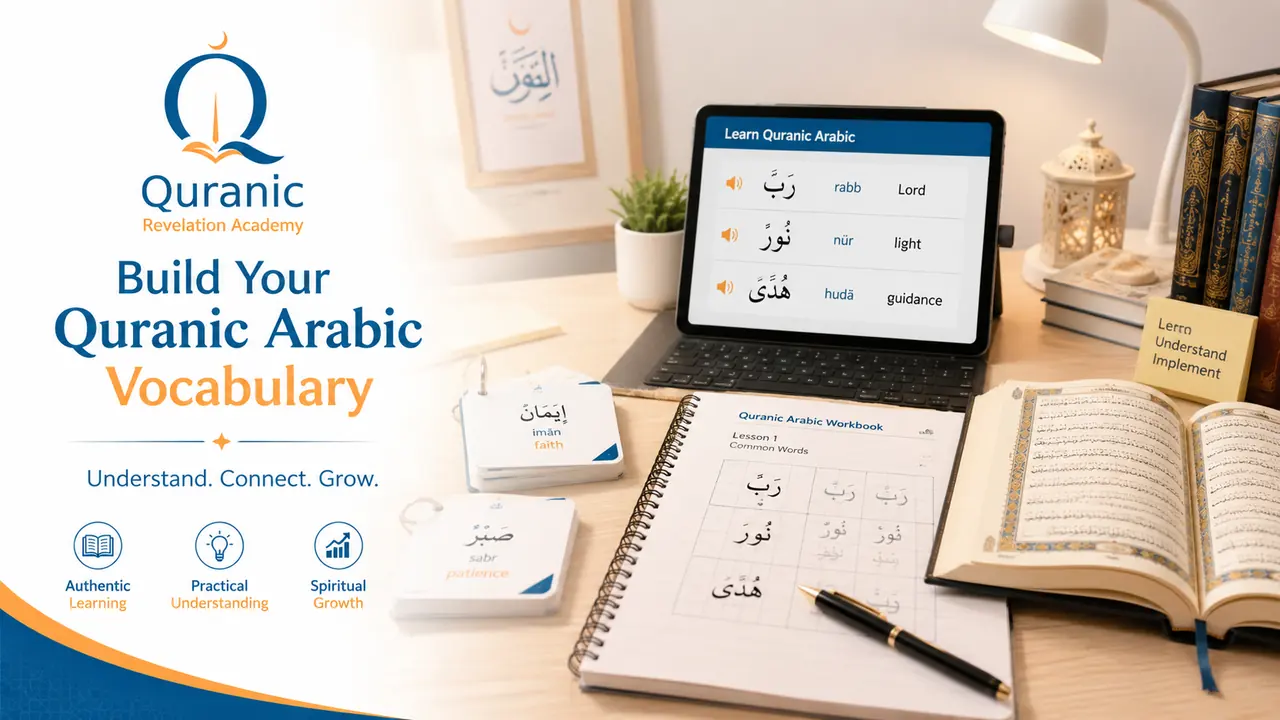
A daily Quran routine does not need to begin with a large target. The strongest routine is usually the one that fits ordinary life, has a very small minimum version and survives the days when motivation is low.
Quick answer:
Choose a reliable time cue, set a small daily minimum, decide whether the session is for reading, review, memorization or understanding, track consistency rather than volume and return immediately after missed days instead of abandoning the routine.
Start by making the routine smaller than your motivation
Motivation is often highest when a new routine is designed. That is exactly when people choose targets that are too large.
A daily minimum should be something you can still do on a difficult day. It might be one page, ten minutes or a short review of several verses.
You are free to continue beyond the minimum when time and energy are available. The minimum exists to protect continuity.
Reserved image: daily-quran-routine-01.webp
A small minimum keeps the routine alive on difficult days.
Attach Quran to a cue that already exists
“Later today” is not a strong schedule. A routine becomes easier when it is connected to an event that already happens reliably.
You might read after Fajr, after another prayer, with morning coffee, after arriving home or before an established bedtime routine.
The exact time is less important than reducing the daily decision: when this cue happens, Quran follows.
Reliable cues reduce the need to decide when to read.
Know what kind of Quran session you are doing
Reading, memorization, revision, Tajweed practice and studying meaning are all valuable, but they place different demands on attention.
A short daily session becomes clearer when it has a purpose. Monday may include new reading, Tuesday may emphasize Hifz review, or the same session may be divided into ten minutes of recitation and five minutes of vocabulary.
The routine should not become so complicated that planning takes longer than reading.
Reserved image: daily-quran-routine-03.webp
Knowing the purpose of the session makes short time more useful.
Use listening intelligently
Dar al-Ifta notes the value of both reading Quran and listening attentively. Listening can therefore support a routine during situations where direct reading is difficult.
It can reinforce familiarity, pronunciation and reflection.
But if your goal is to improve reading or memorization, listening should support rather than permanently replace the active practice of moving your own tongue and recalling the words yourself.
Reserved image: daily-quran-routine-04.webp
Listening can support the routine when used with intention.
Track the habit before tracking the volume
A simple mark showing that you completed the daily minimum can be more useful than recording page totals at the beginning.
The first question is whether the routine is becoming stable.
After several weeks of consistency, increase the amount only if the current target feels easy to maintain. Growth built on stability is safer than repeatedly rebuilding a routine that was too large.
Reserved image: daily-quran-routine-05.webp
Consistency is worth measuring before volume.
Missing one day is a scheduling problem, not the end of the routine
Many routines fail because the learner treats a missed day as proof that the whole plan has collapsed.
Do not wait for Monday, next month or a new motivational wave. Return at the next available session.
A routine becomes resilient when it includes recovery. The ability to restart quickly is part of consistency.
Let the routine evolve with your Quran goals
A beginner may spend most of the daily session on reading foundations. A Hifz student may devote most of it to revision. Someone studying Quranic Arabic may combine reading with vocabulary.
Yaqeen Institute’s discussion about building a relationship with the Quran emphasizes making Quran part of normal life rather than a temporary seasonal project.
The structure can change while the daily relationship remains.
A simple seven-day starter plan
Choose one reliable daily cue.
Set a minimum of ten minutes or another modest amount.
Prepare the mushaf or learning material before the cue arrives.
Use the first days to protect consistency rather than increase volume.
Add a short review component once the routine feels stable.
If you miss a day, resume at the next opportunity without doubling the target.
After two to four weeks, increase the amount only if the minimum feels easy.
Common routine mistakes
Starting with a daily target designed for your most motivated day.
Using an undefined plan such as “I will read sometime today.”
Mixing too many study goals into a short session.
Increasing quantity before the habit is stable.
Treating a missed day as complete failure.
Comparing your daily amount with someone who has a different schedule.
Frequently asked questions
How much Quran should I read every day?
There is no universal amount. Begin with a sustainable minimum and increase it only when consistency is strong.
What is the best time to read Quran?
Choose a time you can protect consistently. A spiritually meaningful time is valuable, but a routine that actually happens is essential.
Does listening count as part of my Quran routine?
Listening attentively is valuable and can support the routine, although active reading and memorization require their own practice when those are your goals.
What should I do after missing several days?
Restart with the minimum version immediately. Avoid trying to compensate with an unrealistic session that makes another interruption more likely.
Should I track pages or minutes?
Either can work. At the beginning, tracking whether the routine happened at all is often more important than maximizing the amount.
A useful live Quran lesson is not a video call where a teacher simply watches you read. It is a structured feedback session: assessment, recitation, correction, explanation, repetition and a clear assignment for the next lesson.
Quick answer:
A good class usually begins with a short review, includes substantial student reading, focuses on specific pronunciation or Tajweed corrections, adapts the pace to the learner and ends with a small practice target.
The first lesson usually begins with listening, not lecturing
Before deciding what you need, the teacher has to hear you.
A short reading sample can reveal whether the main priority is letter recognition, fluency, articulation, Tajweed, memorization accuracy or something else.
The purpose of assessment is not to judge the learner. It prevents the course from spending weeks on material that does not match the real level.
Reserved image: live-online-quran-class-01.webp
The teacher needs to hear the learner before deciding the priority.
Most of the class should contain active student work
Quran reading improves by reading. A lesson where the teacher speaks for forty minutes and the student reads for three minutes may contain useful information, but it offers little time for personalized correction.
The student should regularly produce the skill being learned.
That may mean reading lines from a Qaida, reciting Quran, repeating a difficult sound, applying a Tajweed rule or reviewing memorized verses.
Active reading gives the teacher something real to correct.
Correction is the core advantage of live learning
A recorded lesson explains what correct pronunciation should sound like. A live teacher can compare that model with the exact sound you produced.
Al-Azhar has run remote Quran recitation sessions through Microsoft Teams that combine recitation correction, performance control and practical Tajweed under specialist supervision.
That is essentially the educational value of live online Quran teaching: distance changes the medium, but the cycle of listening and correction remains.
Reserved image: live-online-quran-class-03.webp
Live feedback is the central advantage over recorded-only learning.
A correction should be specific enough to repeat
“Wrong, try again” may occasionally be enough when the student already knows the issue. It is not a complete teaching method.
Useful feedback identifies the sound, demonstrates it and lets the learner attempt the corrected version.
Sometimes the teacher isolates one letter. Sometimes the issue is a vowel, a madd length, ghunnah or stopping position. Good feedback narrows the problem until the student can act on it.
Reserved image: live-online-quran-class-04.webp
Specific correction makes repetition useful.
The teacher should adjust the lesson while it is happening
A curriculum gives direction, but the actual student determines the pace.
If a rule is already stable, there is little value in repeating it for weeks simply because the textbook has more exercises. If a foundational letter is still unstable, moving ahead too quickly creates additional errors.
A live class allows the teacher to make these decisions in real time rather than forcing every learner through an identical recording.
Reserved image: live-online-quran-class-05.webp
A lesson should finish with a clear next step.
Technology matters mainly when it interferes
You do not need an elaborate studio. You need audio clear enough for pronunciation, a stable connection, the correct reading material and a quiet enough environment to hear subtle differences.
Headphones may help some learners. Others sound clearer through a good device microphone.
The goal is for the technology to disappear into the background so teacher and student can concentrate on recitation.
A good lesson ends with a small next step
Before the call ends, the student should know what to practise.
That may be three lines, one Tajweed rule, two difficult letters or a memorized passage that needs strengthening.
Without this bridge between lessons, the next session begins almost from zero. With it, each class becomes part of a continuous learning loop.
A typical 30-minute lesson might look like this
Three to five minutes reviewing the previous assignment.
Ten to fifteen minutes of student reading and direct correction.
Five minutes focused on one recurring pronunciation or Tajweed point.
A short re-reading of the corrected passage.
One clear assignment for practice before the next class.
A brief progress note when necessary.
Signs a live class is not using live learning well
The teacher does almost all the talking.
The student is placed at a level before anyone hears the reading.
Corrections are vague and never revisited.
Every lesson follows the same script regardless of progress.
Technical problems consume a large part of every session.
The student finishes without knowing what to practise.
Frequently asked questions
Do online Quran classes work for pronunciation?
Yes when audio quality is adequate and the teacher actively listens and corrects. Remote Quran correction is also used in institutional teaching settings.
What equipment do I need?
Usually a stable internet connection, a phone, tablet or computer with usable audio, and the Quran or learning material required by the teacher.
Should the teacher or student talk more?
It depends on the lesson, but a reading class should include substantial student reading so the teacher has enough material to assess and correct.
Can beginners take live classes?
Yes. A live beginner class may begin with Arabic letters, vowels and basic reading rather than full Quran pages.
How do I know the class is helping?
Recurring mistakes should gradually decrease, assignments should become clearer and the student should be able to describe what is currently being improved.
Common Quran Recitation Mistakes and How to Fix Them
Most recitation problems become easier to fix once they stop being described as “my reading is bad” and are identified as specific repeatable errors: one letter, one vowel, one Tajweed pattern or one stopping habit.
Quick answer:
Slow down, identify recurring errors, correct difficult letters at their articulation points, distinguish vowels carefully, apply Tajweed in context, record short passages and use live teacher feedback before an incorrect habit becomes automatic.
Mistake one: similar Arabic letters collapse into the same sound
For many learners, the biggest recitation problem is not an advanced Tajweed rule. It is that two Arabic letters are being produced almost identically.
Pairs such as س and ص, ت and ط, ك and ق, ه and ح, or د and ض can be difficult depending on the learner’s first language.
The solution is to isolate the letter. Hear the contrast, practise it with short vowels, place it in a word and then return to the verse. Repeating the whole page without isolating the sound usually repeats the problem instead of fixing it.
Small vowel signs can change the entire reading pattern.
Mistake three: Tajweed is either ignored or exaggerated
After learning ghunnah, qalqalah or heavy letters, beginners sometimes make the new feature far stronger than necessary.
The opposite problem also occurs: reading with no audible difference at all.
Tajweed aims at accurate controlled pronunciation. A rule should be present in its correct measure. Listening to a competent model and then receiving correction is far more useful than trying to create the effect from a written definition alone.
Tajweed should be controlled rather than exaggerated.
Mistake four: speed hides weaknesses
Fast reading can feel impressive because the page moves quickly. It also gives the tongue less time to reach the correct articulation and gives the ear less time to notice what happened.
If the same errors keep returning, reduce the speed until you can control them.
Speed can grow later. A slower accurate reading is a stronger foundation than a fast reading whose mistakes are becoming automatic.
Reducing speed creates room for accurate articulation.
Mistake five: stopping wherever breath ends
Breath is physical, so an unexpected stop will sometimes happen. The important question is what you do next.
Stopping in an awkward place and restarting from the following word can separate parts of a phrase that belong together.
Learn the common stopping signs gradually and ask your teacher where to restart when you have to stop unexpectedly. Good recitation includes managing the verse as a meaningful phrase, not just individual sounds.
A short personal mistake list makes practice much more focused.
Mistake six: practising the error more than the correction
If you are uncertain about a word and repeat it twenty times alone, you may be strengthening the wrong version.
Use a shorter correction loop: hear the correct form, attempt it, receive feedback, repeat the corrected form and then return to it the next day.
Dr. Ayman Swaid’s official material on common recitation mistakes emphasizes exactly this kind of attention to errors that become widespread in recitation.
Turn mistakes into a personal correction list
A general statement like “my Tajweed needs work” is difficult to practise.
A list such as “ق becomes too close to ك”, “I lose shaddah when reading quickly”, and “madd length changes from word to word” is actionable.
Keep the list short. When one error becomes stable, replace it with the next most frequent problem.
A five-step correction method
Record or read a short passage and identify one repeated error.
Listen to the correct sound or rule from a reliable teacher.
Practise only the difficult letter, word or phrase.
Return the corrected form to the full verse.
Test the same point again the following day.
Keep the error on your correction list until it becomes stable.
Habits that make correction harder
Reading faster whenever a difficult word appears.
Repeating an uncertain pronunciation many times alone.
Trying to fix ten errors at the same time.
Memorizing Tajweed terminology without applying it.
Ignoring stopping and restarting.
Changing the pronunciation model constantly between many reciters.
Frequently asked questions
What is the most common Quran recitation mistake?
It varies by learner, but inaccurate articulation of similar Arabic letters and unstable vowels are frequent foundational problems.
Should I record my own recitation?
Yes, as a self-awareness tool. A recording can reveal hesitation and inconsistency, but teacher feedback remains useful for judging exact pronunciation.
Is reading slowly a bad habit?
No. Slow controlled reading is useful while correcting errors. Speed can increase after accuracy becomes more stable.
How many mistakes should I work on at once?
Usually a small number. Focusing on the most frequent two or three problems makes practice more deliberate.
Can Tajweed mistakes become permanent?
Long-standing habits can become automatic, but they can still be corrected through careful listening, feedback and repeated accurate practice.
Learning Quran as an Adult: A Practical Starting Guide
Starting Quran study as an adult is not a late start. Adults often bring clear goals, discipline and life experience, but they may also carry old pronunciation habits or embarrassment about beginning from the basics.
Quick answer:
Start from your real level, accept slow foundational work when necessary, practise in short regular sessions, use live correction, and measure progress against your own previous reading rather than against someone who began years earlier.
Being an adult beginner is more common than it feels
Many adults assume that everyone else learned Quran reading properly as a child. In reality, adult learners arrive with very different histories. Some learned Arabic letters years ago and forgot them. Some can read familiar surahs but struggle with a new page. Others read reasonably well yet have never received systematic Tajweed correction.
The useful starting point is therefore not your age. It is your current skill.
Al-Azhar operates Quran programs specifically for adult learners and uses assessments to measure their level and progress. That is a helpful reminder that serious Quran learning does not belong only to childhood.
Reserved image: learn-quran-as-an-adult-01.webp
Your current level matters more than the age at which you begin.
Do not let embarrassment choose your curriculum
An adult sometimes knows enough to hide weaknesses. You may recognize a word from memory and guess it rather than decode it, or rush through a difficult letter so the hesitation is less obvious.
That protects pride for a few seconds but slows learning for months.
If the foundation needs work, work on the foundation. Returning to letter articulation or short vowels is not moving backward. It is removing the exact obstacle that has been following you into every page.
Returning to foundations can remove years of recurring difficulty.
Live correction is especially valuable for old habits
Pronunciation habits become automatic over time. A sound repeated incorrectly for twenty years may feel completely natural.
A live teacher can identify the precise difference between the sound you intend and the sound you actually produce. The correction may involve tongue position, airflow, lip movement or simply slowing the word down.
The point is not to make you self-conscious about every letter. It is to identify the small number of recurring errors that create most of the difficulty.
Reserved image: learn-quran-as-an-adult-03.webp
Live feedback helps expose habits that are difficult to hear alone.
Build a routine around adult life, not an imaginary empty schedule
Work, family, commuting and changing responsibilities make rigid study plans difficult. This does not mean consistency is impossible.
A fifteen-minute routine that survives a busy week can be more valuable than a one-hour plan that happens only when life becomes unusually quiet.
Place Quran study beside something that already happens reliably: after a prayer, before breakfast, during a quiet lunch break or immediately before another established evening routine.
Reserved image: learn-quran-as-an-adult-04.webp
A routine must fit real life if it is going to survive.
Separate reading, Tajweed, memorization and understanding
Adults often want to repair everything at once. That enthusiasm is useful, but too many simultaneous goals can make progress invisible.
Decide what the main goal of the current period is. Perhaps you are rebuilding reading fluency. Perhaps the reading is already stable and Tajweed is the priority. Perhaps you want Quranic Arabic alongside recitation.
Other goals do not disappear. They simply take a supporting role until the main weakness becomes stronger.
Reserved image: learn-quran-as-an-adult-05.webp
Progress is easier to see when you compare with your own starting point.
Use comparison carefully
Someone who began Quran study at five years old has thousands of hours of exposure you cannot reproduce in a few weeks. Comparing your first month with their twentieth year tells you almost nothing.
Compare instead with your own previous reading. Are unfamiliar words less intimidating? Are repeated mistakes becoming less frequent? Can you hear a mistake that you previously missed?
Those changes are real progress, even before speed changes dramatically.
The goal is a relationship that survives beyond the course
A course can give structure, but the deeper goal is that Quran remains part of ordinary life after the course ends.
Yaqeen Institute’s discussion on building a relationship with the Quran emphasizes starting with sustainable contact rather than waiting for perfect conditions.
For an adult learner, that may mean accepting a modest routine now and allowing it to grow naturally instead of designing a heroic plan that is impossible to maintain.
A realistic first month for an adult beginner
Take a reading assessment and identify the two or three biggest weaknesses.
Choose a minimum daily practice time that fits even busy days.
Correct difficult letters before pushing for speed.
Use each live lesson to obtain a short, specific practice assignment.
Review previous corrections before adding new material.
Record a short reading once a week to notice changes over time.
Reassess after four weeks and change the plan according to actual progress.
Common mistakes adult learners make
Pretending to be more advanced because the basics feel embarrassing.
Trying to study reading, Hifz, Arabic and advanced Tajweed all at once.
Creating a study schedule that does not fit normal working life.
Comparing progress with lifelong readers.
Practising pronunciation for long periods without correction.
Stopping completely after one busy week.
Frequently asked questions
Is it too late to learn Quran properly as an adult?
No. Adults regularly begin or restart Quran study. The appropriate plan depends on the current reading level, not the age at which formal study began.
Should I restart from the Arabic alphabet?
Only if your assessment shows that letter recognition or basic decoding is still unstable. Otherwise you can begin from the specific weaknesses you actually have.
How much should a busy adult practise?
A small amount that happens consistently is more useful than a large target that repeatedly disappears. Even ten to fifteen focused minutes can support steady progress.
Can adults correct pronunciation habits learned years ago?
Yes, although established habits may take repeated listening and correction. Specific feedback and deliberate repetition are especially useful.
Should I memorize while improving my reading?
You can, but keep the amount manageable and make sure memorization does not reinforce pronunciation errors that are still being corrected.
Learn Quranic Arabic: From Letters to Understanding
Learning Quranic Arabic is not about memorizing an enormous grammar book before understanding a single verse. A useful path connects reading, vocabulary and grammar directly to language you repeatedly meet in the Qur’an.
Quick answer:
Build accurate Arabic reading first, learn high-frequency Quranic vocabulary, study basic sentence patterns and morphology in context, then deepen understanding through reliable tafsir rather than guessing meanings from vocabulary alone.
Quranic Arabic and everyday spoken Arabic are related, but not identical goals
A learner who wants to understand the Quran has a different immediate goal from someone preparing for everyday conversation in Cairo or Casablanca.
Both benefit from Arabic foundations, but Quranic study places special attention on Classical Arabic vocabulary, grammatical structures and the way words are used in revelation.
This does not make spoken Arabic useless. It simply means the study plan should reflect why you are learning the language in the first place.
Reserved image: learn-quranic-arabic-01.webp
Comfortable reading frees attention for meaning.
Start with reading that no longer consumes all your attention
If every Arabic word still requires several seconds to identify each letter, grammar explanations quickly become exhausting.
You do not need perfect fluency before beginning vocabulary, but basic decoding should become sufficiently comfortable that your attention can begin shifting from “What letter is this?” to “What does this word mean here?”
Al-Azhar maintains dedicated programs and institutes for teaching Arabic to non-native speakers, reflecting the fact that second-language learners need structured language teaching rather than simply being placed in native-level material.
Repeated Quranic vocabulary is easier to remember when seen in context.
Build vocabulary from words you actually meet repeatedly
A random vocabulary list may teach useful Arabic, but Quranic vocabulary study becomes more motivating when words repeatedly reappear in the text you are reading.
Learn a modest number of words, then notice them in different verses. Pay attention to how a familiar root can appear in several forms.
Do not expect one English translation to capture every use of an Arabic word. Vocabulary gives you access to the sentence, but context and interpretation still matter.
Reserved image: learn-quranic-arabic-03.webp
Grammar becomes useful when it reveals relationships inside real verses.
Learn enough grammar to see relationships inside the verse
Grammar becomes useful when it answers real questions: Who is performing the action? What is being described? Which noun belongs to another noun? Why did the ending of this word change?
Begin with broad categories such as nouns, verbs and particles, then simple nominal and verbal sentences, pronouns, adjective relationships and common prepositions.
Later, morphology helps you recognize families of related forms. The purpose is not collecting labels. It is seeing more of the structure that was previously invisible.
Reserved image: learn-quranic-arabic-04.webp
The Quran itself becomes a recurring practice environment.
Do not turn vocabulary knowledge into personal tafsir
Understanding more Arabic can transform the experience of reading the Quran, but knowing a root or grammatical pattern does not automatically settle the interpretation of a verse.
Words operate inside context, rhetoric and a wider scholarly tradition. Use Arabic knowledge to read more intelligently, then consult reliable tafsir for explanation rather than assuming the first dictionary meaning must be the intended meaning.
Language study should increase humility and precision, not produce greater confidence in guesses.
Reserved image: learn-quranic-arabic-05.webp
A teacher can keep language study structured and connected to the learner’s goal.
Use the Quran itself as a recurring practice environment
After learning a grammatical pattern or a group of words, return to a short surah and look for them. This turns abstract study into recognition.
A verified Bayyinah discussion on learning Arabic for Quranic understanding emphasizes a sustained journey rather than expecting instant access to the language.
Regular exposure matters. Twenty minutes several times a week usually creates a stronger connection than studying intensely once and then forgetting the material for a month.
Measure comprehension in layers
At first, success may simply mean recognizing ten words in a familiar surah. Later you begin identifying sentence structure. Later still, you notice why a particular form or word order matters.
Do not dismiss the early layers because they feel small. Language knowledge compounds.
The goal is not to stop using translation or tafsir as quickly as possible. The goal is to understand more of the Arabic while using scholarly tools more intelligently.
A practical beginner sequence
Stabilize Arabic letters, vowels and joined reading.
Learn a small set of high-frequency Quranic words.
Study basic nouns, verbs and particles.
Learn simple nominal and verbal sentence patterns.
Introduce common pronouns, prepositions and adjective structures.
Begin basic morphology and word families.
Apply every new concept to verses you already read.
Use reliable tafsir when moving from language to interpretation.
Common mistakes when learning Quranic Arabic
Trying to master all grammar before reading real text.
Memorizing isolated vocabulary without revisiting it in verses.
Assuming one dictionary gloss explains every Quranic use of a word.
Jumping into interpretation beyond what the language study actually proves.
Ignoring reading fluency while focusing entirely on grammar.
Studying irregularly in very large bursts.
Frequently asked questions
Do I need to speak Arabic fluently to understand Quranic Arabic?
No. Quranic comprehension and everyday conversational fluency overlap, but they are not identical goals. You can study Quran-focused vocabulary and grammar without first becoming a fluent speaker.
Should I learn grammar or vocabulary first?
A small amount of both works well. Vocabulary lets you recognize content, while basic grammar shows how the words relate to one another.
How many words should I memorize?
Start with a manageable group of high-frequency words and revisit them repeatedly in Quranic context instead of chasing a very large list.
Can Arabic replace tafsir?
No. Arabic knowledge helps you understand the text more directly, but tafsir addresses context, interpretation and scholarly explanation beyond vocabulary and grammar alone.
How long does Quranic Arabic take to learn?
There is no single deadline. Reading background, study frequency and the depth of understanding you want all change the timeline.
Quran Memorization Plan: Build a Sustainable Hifz Routine
A memorization plan works only if revision survives after the excitement of learning new pages fades. Sustainable Hifz is built around realistic new material, strong review and a routine that can continue on ordinary days.
Quick answer:
Choose a small daily amount, memorize accurately, review older material every day, recite regularly to a teacher and increase the target only when previous memorization remains stable.
Hifz is not only a system for adding new verses
The most exciting part of memorization is usually the new portion. It gives a visible feeling of progress: another half-page, another surah, another milestone.
But the real test of a memorization system is what happens to material learned three weeks or six months ago. If new pages keep arriving while old pages quietly disappear, the plan is producing collection rather than preservation.
A sustainable Hifz routine therefore treats revision as part of memorization itself, not as an optional activity saved for the future.
Reserved image: quran-memorization-plan-01.webp
A sustainable plan begins with an amount you can repeat consistently.
Choose a target you can repeat on an ordinary day
A target is useful only when it fits the learner’s real schedule and current ability. One student may maintain half a page a day, while another needs several days for the same amount.
The correct amount is not the largest amount you can memorize once. It is the amount you can learn accurately while still protecting yesterday’s and last month’s work.
Al-Azhar’s Quran memorization initiatives repeatedly combine memorization with review and mastery. That pairing is important: the goal is not merely reaching the end of a page, but keeping it.
Small measurable targets make progress easier to maintain.
Memorize cleanly before increasing quantity
If the new passage contains unstable pronunciation or repeated hesitation, adding more material creates a larger revision problem tomorrow.
Read the passage correctly first. Divide it into manageable phrases, listen carefully, repeat without rushing and connect the phrases only after the smaller sections become stable.
A teacher can also stop mistakes before they become attached to the memorized wording. Correcting an error after hundreds of repetitions can be far harder than correcting it on the first day.
Reserved image: quran-memorization-plan-03.webp
Accuracy on the first day reduces correction work later.
Separate new memorization from recent and older review
Many learners benefit from thinking in three layers: today’s new portion, recent material from the last days or weeks, and older memorization that needs periodic circulation.
These layers do not have to be equal in size. In fact, as the memorized amount grows, review often needs more time than new memorization.
If an older section becomes weak, reducing the new target temporarily is not failure. It is maintenance of the foundation that allows future memorization to remain useful.
Reserved image: quran-memorization-plan-04.webp
New memorization and old review need separate space in the schedule.
Use listening as support, not as a substitute for recall
Listening to a skilled reciter can help establish pronunciation, rhythm and the sequence of verses. It is especially useful before memorizing a difficult passage.
But recognition is easier than recall. A verse may feel familiar while the recitation is playing and disappear when the audio stops.
Turn the recording off regularly and test yourself from memory. Recite from the beginning of the passage, start from the middle and ask a teacher or partner to prompt you from unexpected points.
Reserved image: quran-memorization-plan-05.webp
Regular recitation to someone else exposes weak points quickly.
Consistency matters more than heroic bursts
A very ambitious weekend followed by five empty days is difficult to build on. Memorization benefits from frequent retrieval because the material is repeatedly brought back into active memory.
The daily amount can be small. The important part is that the relationship with the memorized material continues.
A Yaqeen Institute discussion on building a relationship with the Quran makes a similar practical point about integrating Quran into normal life rather than waiting for an ideal schedule. For Hifz, that principle is especially valuable.
Let weakness change the plan before it becomes a crisis
If yesterday’s portion is repeatedly collapsing, do not keep increasing the new assignment simply because the schedule says so.
Pause, reduce or temporarily stop new memorization and repair the weak section. A flexible plan is often more sustainable than a rigid plan that looks impressive on paper.
The best long-term target is not the fastest possible completion date. It is reaching the next stage with enough stability that the earlier Quran remains available to you.
A practical 30-day Hifz structure
Choose a modest daily new portion for the first week.
Review yesterday’s material before starting anything new.
Create a separate block for older memorization.
Recite to a teacher regularly and record repeated mistakes.
At the end of each week, test the entire week without looking.
Reduce new material when previous portions become unstable.
Increase the target only after the routine feels comfortably sustainable.
Common memorization mistakes
Making the new portion much larger than the revision capacity.
Memorizing before the pronunciation is stable.
Listening repeatedly without testing independent recall.
Reviewing only the most recently memorized pages.
Refusing to reduce the target when older memorization becomes weak.
Comparing completion speed with another student.
Frequently asked questions
How much Quran should I memorize each day?
There is no universal amount. Choose a portion you can memorize accurately while still reviewing recent and older material.
Should I memorize every day?
Daily contact is useful, but not every day needs new material. Some days may be devoted entirely to review.
What should I do when old memorization becomes weak?
Reduce or pause new memorization temporarily and rebuild the weak sections through repeated recall and correction.
Is listening enough for memorization?
Listening supports pronunciation and familiarity, but strong memorization requires recalling the passage without the recording.
Do I need a teacher for Hifz?
A teacher is especially helpful for correcting recitation, checking accuracy and identifying mistakes that the learner may not notice independently.
Online Quran Classes for Children: A Parent’s Guide
A good Quran class for a child should build accurate reading, confidence and consistency without turning every lesson into pressure. The teacher, lesson length, practice routine and parent role all matter.
Quick answer:
Choose live teaching with a teacher experienced with children, begin from the child’s actual reading level, keep practice realistic, introduce Tajweed gradually and make sure parents receive enough feedback to understand progress.
Begin with the child’s real level, not the number on their birthday
Two children of the same age can need completely different Quran lessons. One may already read Arabic comfortably, another may still be learning individual letters, while a third may have memorized several short surahs by listening but cannot yet decode a new line from the mushaf.
That is why the first useful question is not simply “How old is the child?” It is “What can this child actually read independently today?”
A short assessment can look at letter recognition, short vowels, joined letters, unfamiliar words, fluency and recurring pronunciation problems. This prevents a child from being placed in material that is frustratingly advanced or so easy that attention disappears.
A good starting point is the child’s actual reading ability.
Age-appropriate teaching should still be serious teaching
Making a lesson suitable for children does not mean removing substance from it. Children can learn correct articulation, basic Tajweed, careful reading and memorization. The difference is in how those skills are presented.
Al-Azhar’s recently introduced simplified Tajweed curriculum for primary pupils is built around gradual learning and practical application suited to younger students. That is a useful model for parents to remember: serious knowledge can be presented in smaller, clearer steps.
A child usually benefits more from hearing one sound, trying it, being corrected and repeating it in a real Quranic word than from memorizing a page of terminology before understanding what the words describe.
Children can learn serious skills when they are presented in manageable steps.
The teacher needs to hear the child, not only present information
Recorded lessons can demonstrate Arabic letters and Tajweed rules, but they cannot tell a child that the sound they just produced came from the wrong articulation point.
Live correction matters because young learners often repeat what feels familiar. If a pronunciation has been wrong for months, it may sound completely normal to the child.
A good teacher does not interrupt every second, but notices the mistakes that matter, isolates them and gives the child another chance to produce the sound correctly. The lesson becomes a cycle of reading, listening, correction and repetition.
Live correction helps prevent small pronunciation errors from becoming habits.
Short focused lessons can outperform long exhausted lessons
More minutes do not automatically mean more learning. A younger child who is mentally present for twenty-five focused minutes may learn more than one who spends the final half of a long session looking away from the screen.
Lesson length should therefore depend on age, concentration, reading level and teaching style. The useful question is not only how long the class lasts, but how much of that time the child is genuinely engaged.
For some learners, several shorter contacts with the Quran during the week are easier to sustain than one very long lesson followed by six days with no review.
A small routine that really happens is more useful than an ambitious one that does not.
Reading and memorization are different skills
A child can recite a familiar surah beautifully from memory and still struggle to read an unfamiliar word. That is not unusual. Memorization and reading support each other, but they are not the same skill.
Parents should know which ability the current lesson is developing. If the focus is memorization, independent reading should not quietly disappear. If the focus is reading, memorization can still continue in a manageable amount.
The strongest long-term program usually makes both skills visible: the child can preserve what has been memorized while gradually becoming less dependent on hearing every new passage first.
Structure and encouragement can exist in the same lesson.
Parents should support the system without becoming the second teacher
Parents have an important role in education, but that role does not require correcting every technical Tajweed detail at home. If a parent is unsure about a pronunciation, it is often better to note the word and ask the teacher than to reinforce an uncertain correction.
A parent can protect the lesson time, prepare the device and mushaf, remind the child about a small practice assignment and ask what was learned. Those simple actions make the class feel like an important part of family life.
Children also notice whether the adults around them value Quran learning themselves. When the Quran is treated only as an obligation imposed on the child, that message is heard very quickly.
Progress should be visible in quality, not just page numbers
Parents naturally like measurable progress, so page counts and memorized surahs are tempting indicators. They tell only part of the story.
Look for fewer repeated pronunciation mistakes, quicker recognition of letters, less guessing at unfamiliar words, better memory of corrections from the previous lesson and greater comfort reading aloud.
A child who reads less material but is steadily becoming more accurate may be progressing far better than one who races through pages while repeating the same errors.
A simple weekly structure for a young learner
Use the live class for reading, listening and direct correction.
Review the exact corrected lines for five to ten minutes the following day.
Practise one pronunciation or Tajweed target in the middle of the week.
Read the assigned section once before the next class.
Keep a short note of words that still feel difficult.
Ask the teacher periodically what has improved and what comes next.
Common mistakes parents can avoid
Choosing a level only by age.
Measuring every success by the number of pages completed.
Making practice so long that the child begins to resist it.
Correcting pronunciation at home when the parent is unsure of the correct sound.
Changing teachers repeatedly before giving a reasonable teaching plan time to work.
Ignoring persistent anxiety or frustration around reading aloud.
Frequently asked questions
What age should a child begin online Quran classes?
There is no universal age. A child can begin when they can interact with the teacher and follow a short structured lesson. Very young learners may begin with letters, sounds and short surahs.
Should children learn Tajweed from the beginning?
Correct pronunciation should matter from the beginning, while detailed Tajweed terminology can be introduced gradually as the child’s reading develops.
Should reading come before memorization?
They can develop together. The important point is to recognize that memorizing a passage and independently reading a new passage are different skills.
How often should a child practise?
Short regular practice is usually more sustainable than occasional long sessions. The appropriate amount depends on age, level and attention.
What if my child does not connect with the teacher?
First identify whether the problem is ordinary resistance to correction or a genuine teaching mismatch. If communication and engagement consistently fail, another teacher may be more suitable.
A good Quran teacher is not simply someone who recites beautifully.
The right teacher should hear your mistakes, know how to correct them,
adapt the lesson to your level, and give you a clear path forward
without making the learning process unnecessarily complicated.
Quick answer:
look for accurate Quran recitation and Tajweed, relevant teaching experience,
clear correction, patience, a structured learning plan, good communication
and a trial lesson where you can see how the teacher actually works with you.
Credentials matter, but teaching ability and student-teacher fit matter too.
Choosing an online Quran teacher can be surprisingly difficult.
Search for a few minutes and almost every profile sounds the same:
qualified, experienced, certified, patient, professional and flexible.
Those words are useful only when you can see what they mean in an actual lesson.
A teacher may have a beautiful recitation but struggle to explain why you keep
mispronouncing one letter. Another may know a large amount of theory but move
so quickly that a beginner spends the entire lesson trying to catch up.
The right question is therefore not: “Who has the most impressive profile?”
A better question is: “Who can identify what I need and help me improve it consistently?”
A trial lesson tells you more about a teacher than a long list of marketing claims.
1. Start with the teacher’s Quran reading, not the website
The first requirement is obvious but important:
someone teaching Quran reading should themselves be able to recite accurately.
Egypt’s Dar al-Ifta
states that the principle is that Quran reading should be taught
by someone who has mastered the rulings of recitation.
That does not mean you need to interrogate every teacher with a twenty-page exam.
But it does mean that “speaks Arabic” and “can teach Quran” are not identical claims.
Listen to the teacher recite.
Pay attention to the clarity of the letters,
the consistency of the Tajweed,
the pacing and whether the recitation sounds controlled rather than rushed.
If your goal is specifically learning Tajweed,
the teacher should be able to explain the rules they are correcting,
not simply tell you to imitate them.
2. Ask what their qualification actually qualifies them to teach
You may see terms such as certificate, degree, sanad or ijazah
in a teacher’s profile.
An ijazah is traditionally an authorization from a teacher
to transmit a particular text or area of knowledge,
usually connected to direct teacher-to-student study.
In Quran recitation, it can be a valuable indication
that the teacher’s own recitation has gone through a formal process.
But a credential should lead to another question: what exactly is it in?
A qualification in Quran memorization is not necessarily
the same as qualification in a particular qira’ah,
Tajweed instruction,
Arabic language
or teaching young children.
The Al-Azhar General Administration for Quran Affairs
describes Quran teachers as specialists in memorization and Tajweed,
while its supervisory system evaluates teachers
and links Quran teaching to appropriate educational
and specialist qualifications.
In another Al-Azhar recruitment notice,
candidates teaching Quran were required to demonstrate strong command
of Quran recitation and Tajweed,
pass oral testing
and complete specialist training.
The useful lesson for a student is simple:
credentials are worth checking,
but ask what they represent rather than collecting impressive titles.
A qualification is useful when it matches the subject the student actually needs.
3. Teaching skill is different from recitation skill
This is one of the easiest things to miss.
Someone can be an excellent reciter
and still find teaching difficult.
Teaching requires another set of skills:
watching how a student learns,
breaking a problem into small steps,
explaining the same idea in different ways
and knowing when to move forward.
A beginner who cannot distinguish two Arabic letters
does not need a five-minute lecture full of advanced terminology.
The student needs to hear the difference,
see how the sound is produced,
try it,
receive a correction
and try again.
Likewise, an advanced student should not spend month after month
repeating material they already control.
This idea of adapting teaching to the learner
is discussed beautifully in this Bayyinah video:
For your practical decision,
look for a teacher who changes pace when necessary.
If you struggle, they slow down.
If you understand quickly, they do not manufacture difficulty
just to fill the lesson time.
4. Watch how the teacher corrects mistakes
Correction tells you a great deal about teaching quality.
Imagine that you pronounce a letter incorrectly.
A weak correction may simply be:
“Wrong. Again.”
A useful correction sounds more like:
“This is the sound that changed.
Listen to the correct one.
Watch where the tongue is placed.
Now read only this word again.”
The difference is enormous.
The student should leave the correction understanding what was wrong and what to do differently.
Al-Azhar’s Quranic training initiatives describe practical teacher development
that includes correct pronunciation,
the articulation points of letters
and their characteristics.
That practical emphasis matters because Quran reading is not learned
through definitions alone.
The teacher has to hear what actually comes out of the student’s mouth.
The best correction is specific enough for the student to act on immediately.
5. Ask whether they have taught students like you
Experience matters,
but the type of experience matters more than the number of years
written in a biography.
If you are a complete beginner,
ask whether the teacher regularly teaches people
who do not yet read Arabic.
If the student is six years old,
ask about experience teaching young children.
If you already recite confidently
and want advanced Tajweed correction,
ask whether the teacher works with students at that level.
If you are an adult returning to Quran after many years,
you may need a teacher comfortable correcting established habits
without treating you like a child.
That is why we built separate learning paths for children
and adult Quran learners.
The goal may be Quran learning in both cases,
but the teaching approach should not be identical.
6. Patience does not mean avoiding correction
A patient teacher is not someone who allows the same error
to continue forever because correction might feel uncomfortable.
Good patience means correcting without humiliating the student,
repeating an explanation when needed
and understanding that some sounds may take many attempts.
There is a useful balance here.
Too little correction and the student does not improve.
Too much interruption and the student never develops flow.
An experienced teacher learns when to stop immediately
and when to let the student finish a short phrase
before returning to the error.
7. Look for a visible learning plan
Ask the teacher: “If I study with you for the next three months, what are we working toward?”
The answer does not need to be a rigid promise.
Learning speed varies too much for that.
But there should be some structure.
For example:
assess current reading;
correct the most important articulation problems;
stabilize basic reading;
introduce relevant Tajweed rules;
review previous mistakes;
measure whether the same errors are decreasing.
A lesson should not feel as if both teacher and student
are discovering the plan five seconds after the call begins.
A student should know what they are working on and why it matters.
8. Use the trial lesson properly
A trial lesson is not only an opportunity to ask about price and schedule.
It is your best chance to observe the teaching itself.
Try to read something during the trial,
even if you are nervous.
Without hearing you,
the teacher cannot demonstrate much of their actual teaching ability.
Pay attention to five things:
Does the teacher listen before deciding your level?
Are corrections specific?
Can you understand the explanation?
Does the teacher adjust when you struggle?
Do you leave knowing what you should practise next?
For a child,
a parent can also observe whether the teacher
keeps the learner engaged without turning every thirty seconds
into entertainment.
There should still be a real lesson taking place.
9. Do not choose only by price
Budget matters.
There is nothing wrong with comparing tuition costs.
But the cheapest lesson becomes expensive
if you spend a year reinforcing errors
and then need another teacher to rebuild your pronunciation.
At the same time,
a high price is not proof of high teaching quality.
Compare what is actually included:
lesson length,
one-to-one or group teaching,
teacher consistency,
feedback,
progress tracking,
rescheduling policies
and the teacher’s relevant expertise.
The useful metric is not simply price per hour.
It is whether those hours are producing meaningful progress.
10. For children, ask about safeguarding and parent communication
When the learner is a child,
there are additional questions beyond Tajweed.
Parents should know who is teaching,
how lessons are supervised,
how communication takes place
and who to contact if something needs to change.
For younger learners,
it can also be useful for a parent
to remain nearby during online sessions,
especially at the beginning.
The relationship should be professional,
clear
and transparent.
Not every excellent teacher is the right teacher for every student.
Some learners respond well to a very structured style.
Others need a calmer pace.
Some children become motivated by frequent encouragement,
while another student prefers brief correction
and more uninterrupted reading time.
This does not mean the teacher should simply tell the student
whatever they want to hear.
It means effective teaching happens inside a real human relationship.
The student should feel comfortable enough to make mistakes aloud,
while still respecting the seriousness of learning Quran.
shows how assessment, correction and practice can fit together in a normal lesson.
Frequently asked questions
Does a Quran teacher have to be a native Arabic speaker?
No.
Native Arabic speech by itself does not prove mastery of Quran recitation
or teaching ability.
What matters is accurate recitation,
relevant knowledge,
good instruction
and the ability to correct the student’s reading.
Does every Quran teacher need an ijazah?
An ijazah can be a valuable credential,
especially for advanced recitation and transmission.
But students should still ask what the ijazah covers
and whether the teacher can actually teach their particular level effectively.
Should children have a different teacher from adults?
Not necessarily,
but the teacher should have experience with the relevant age group.
Teaching a six-year-old beginner requires different pacing
and communication from teaching an adult Tajweed student.
How many trial lessons should I take?
There is no required number.
Sometimes one lesson makes the fit very clear.
If you are uncertain,
trying another teacher can help you compare teaching styles
before committing.
What matters more: qualifications or experience?
Neither should completely replace the other.
Qualifications can demonstrate study and recitation standards.
Teaching experience shows whether that knowledge
can be communicated effectively to real students.
Use a free trial lesson to let a teacher hear your current reading,
identify the areas that need attention
and see whether the teaching style works for you.
Tajweed for Beginners: The Rules That Matter First
Tajweed becomes much less intimidating when you stop treating it as a long list
of Arabic terms and start treating it as a practical way to make your Quran
recitation clearer, more accurate and more consistent.
Quick answer:
a beginner should usually focus first on correct letter pronunciation,
the differences between similar Arabic sounds, noon sakinah and tanween,
meem sakinah, basic madd, and learning how to stop and restart without
distorting the words.
The word Tajweed
can sound more complicated than it really is.
A new student hears terms such as ikhfa, idgham, qalqalah, ghunnah and madd,
and suddenly Quran reading feels like a technical subject rather than an act
of recitation.
But Tajweed is not supposed to make reading harder.
Its practical purpose is the opposite:
to help you pronounce the words of the Qur’an correctly,
give each letter its proper sound,
and avoid habits that can damage the clarity of your recitation.
The mistake is trying to learn every rule before you have learned
how to hear and produce the basic sounds.
For most beginners, there is a much better order.
Reserved image: tajweed-for-beginners-01.webp
Tajweed is easier when each rule is connected to real recitation.
What does Tajweed actually mean?
In practical study, Tajweed is about giving Arabic letters
their correct pronunciation and observing the rules
that govern how sounds interact during Quran recitation.
Egypt’s Dar al-Ifta
distinguishes between correct recitation needed to protect words and meanings
and additional refinements connected to the detailed properties
and articulation of letters.
That distinction is useful for a beginner.
You do not have to become a specialist in every technical detail
before you are allowed to improve your reading.
You begin with the errors that affect pronunciation most directly,
then develop precision step by step.
Rule zero: learn where the letters actually come from
Before memorising a table of Tajweed rules,
you need to hear and feel the difference between Arabic letters.
This is the study of makharij, or points of articulation.
Some letters come from the throat.
Others involve different parts of the tongue,
the lips or the nasal passage.
A student who does not distinguish these sounds clearly
may continue repeating the same mistake
even after memorising the name of every Tajweed rule.
Official Al-Azhar educational materials
place the study of articulation points and letter characteristics
alongside the major beginner Tajweed topics.
This order makes sense:
before asking what happens when two letters meet,
first make sure each individual letter has its own identity.
Use demonstrations like this as practice aids,
but let a teacher listen to you as well.
Watching the mouth position is useful;
hearing whether your sound is correct requires feedback.
1. Start with letters that are commonly confused
For non-native Arabic speakers,
some pairs of letters can sound almost identical at first.
Examples include ح and ه,
ع and أ,
ص and س,
ض and د,
ط and ت,
and ق and ك.
The goal is not simply to know that two letters are different.
You need to produce that difference reliably
while reading a complete word.
A useful exercise is to isolate the difficult letter,
repeat it with different vowels,
then return it to a short Quranic word.
Do not spend twenty minutes saying an incorrect sound repeatedly.
If you are uncertain,
ask your
online Quran teacher
to correct the articulation first.
Reserved image: tajweed-for-beginners-02.webp
Correcting a difficult letter early prevents the same error from spreading into many words.
2. Learn noon sakinah and tanween as a group
One of the first major rule groups students usually encounter
concerns noon sakinah and tanween.
Depending on the letter that follows,
the sound may be pronounced clearly,
merged,
changed,
or partially concealed with nasalisation.
These categories are commonly taught as:
Izhar: clear pronunciation.
Idgham: merging one sound into the next.
Iqlab: changing the noon sound in a specific context.
Ikhfa: concealing the sound between full clarity and full merging.
Al-Azhar’s published beginner Tajweed curriculum includes
noon sakinah and tanween,
idgham,
iqlab and ikhfa as part of the progression.
The easiest way to learn these rules is not by staring at a chart.
Study one category,
find several examples in the mushaf,
listen to them,
then read them aloud.
A good beginner habit:
when you learn a new rule, mark three examples in the page you are already reading.
That connects the rule to real Quran recitation instead of leaving it inside a notebook.
3. Then study meem sakinah
The rules of meem sakinah
are generally easier to organise once the student understands
the idea that pronunciation can change slightly
according to the following letter.
You will encounter clear pronunciation,
concealment in a specific situation,
and merging when one meem meets another.
Again, the terminology matters less at first than the sound.
Your teacher should be able to say,
“Listen to this example,”
then let you imitate it and explain why it sounds that way.
Once the ear recognises the pattern,
the Arabic name of the rule becomes much easier to remember.
4. Understand ghunnah without exaggerating it
Ghunnah is the nasal quality heard in particular Tajweed situations.
Beginners often make one of two mistakes:
they hardly produce it at all,
or they stretch it so strongly that it becomes unnatural.
The best correction is auditory.
Listen to a controlled example,
repeat it,
then compare your duration and sound with the teacher’s model.
Tajweed is full of this principle:
more is not automatically better.
Accuracy is the target.
Reserved image: tajweed-for-beginners-03.webp
Hearing the difference is an important part of learning to produce it.
5. Learn basic madd before memorising every type
Madd refers to elongation.
It is an important part of Quran recitation,
but beginners sometimes meet long lists of categories
before they are comfortable with the basic concept.
Start by learning which letters create natural elongation
and how to keep the length consistent.
Then add the situations where the length changes.
Al-Azhar’s Tajweed materials also place
madd and qasr among the structured areas
studied after foundational rules.
A teacher can help enormously here
because timing is difficult to learn from written descriptions alone.
The difference between “two counts” and “four counts”
becomes much clearer when you hear it and repeat it.
6. Qalqalah should sound clear, not theatrical
Another rule beginners notice quickly is qalqalah,
the slight echoing quality associated with particular letters
when they carry sukoon.
A common mistake is adding a complete vowel
after the letter.
The sound should not turn a closed consonant
into a new syllable.
This is another reason slow practice matters.
Read the word,
stop,
listen to the final consonant,
and make sure you did not accidentally add
an extra a, i or u.
7. Do not ignore stopping and starting
Many beginners focus entirely on letter pronunciation
and forget that where they stop can also affect clarity.
When you run out of breath,
you cannot always stop at an arbitrary place
and then restart from the next word.
Some locations create an incomplete
or misleading phrase when separated from what follows.
At the beginner level,
you do not need to memorise every symbol immediately.
Start by recognising the most common pause marks
and asking your teacher where a restart should begin
when you stop unexpectedly.
Good recitation is not only about producing letters correctly.
It is also about allowing the verse to remain intelligible
while you read it.
Reserved image: tajweed-for-beginners-04.webp
Learning when to pause is part of learning how to recite a verse clearly.
What should you practise first?
If your Tajweed feels overwhelming,
use this order for the next several weeks:
Correct your weakest Arabic letters.
Practise the basic vowel sounds and shaddah accurately.
Study noon sakinah and tanween.
Add meem sakinah.
Practise controlled ghunnah.
Learn natural madd and then the common extended forms.
Work on qalqalah.
Begin recognising basic stopping signs.
This is not the only possible Tajweed curriculum,
and a teacher may change the order
because of the mistakes heard in your recitation.
That is a good thing.
A learning plan should serve the student,
not force every student through the same page
at the same speed.
A simple 15-minute Tajweed practice routine
Minutes 1–3: warm up difficult letters
Choose two letters you regularly confuse.
Read each with fathah, kasrah and dammah,
then place the sound inside a real word.
Minutes 4–8: practise one rule
Do not revise the entire Tajweed syllabus.
Choose one rule from your current lesson
and locate several examples.
Minutes 9–12: read a short passage
Read several verses slowly
while looking specifically for the rule you practised.
Minutes 13–15: record and listen
Record a short portion on your phone,
listen once,
and note one mistake to ask your teacher about.
The purpose is not to become your own final judge.
Recording simply makes you more attentive
before your next live correction.
Why a live teacher still matters
Tajweed has a physical component.
Tongue position,
airflow,
lip movement,
nasalisation
and sound duration cannot always be learned
from text alone.
That is why structured Quran teaching has traditionally relied heavily
on listening and correction.
Al-Azhar’s Quranic training initiatives likewise describe
practical instruction in correct pronunciation,
articulation points and letter characteristics.
If you are learning remotely,
the important question is therefore not simply
“Is this an online course?”
but: does someone actually listen to me read?
Tajweed improves fastest when explanation is followed by listening, correction and repetition.
Common Tajweed mistakes beginners make
Memorising names without recognising sounds
Being able to define ikhfa is useful,
but it is not enough if you cannot recognise
or produce it inside a verse.
Trying to sound like a famous reciter
Beautiful recitation can inspire you,
but imitating vocal style is not the first priority.
Start with correct letters and rules.
Your natural voice does not need to sound like anyone else’s.
Reading too quickly
Speed hides weaknesses.
Slow reading gives your mouth enough time
to produce the correct articulation
and gives your ear enough time
to notice the result.
Overcorrecting
Students sometimes exaggerate heavy letters,
ghunnah or qalqalah after first learning about them.
A rule should be present,
not theatrical.
Ignoring repeated mistakes
If your teacher has corrected the same sound five times,
write it down.
That is more valuable than collecting ten new rules.
You do not need to memorise an entire Tajweed curriculum
before opening the Qur’an.
Correct pronunciation should be developed from the beginning,
while detailed rules can be introduced gradually.
What is the most important Tajweed rule for a beginner?
There is no single rule that replaces the others.
For many beginners,
accurate letter articulation is the most useful starting point
because every later rule depends on producing the letters correctly.
Can I learn Tajweed only from YouTube?
Videos are useful for explanations and demonstrations,
but they cannot reliably hear your personal pronunciation.
For that reason,
combine self-study with feedback from a competent teacher whenever possible.
How many Tajweed rules should I study at once?
Usually fewer is better.
Learn one small group,
apply it repeatedly in real verses,
then add another rule once the first is recognisable during reading.
How long does it take to learn Tajweed?
There is no universal deadline.
A student who already reads Arabic fluently
may progress faster through the rules,
while another student may need more time
to stabilise articulation first.
A live lesson can identify the Tajweed and pronunciation points
that matter most for your current level,
instead of making you guess which rule to study next.
How to Learn Quran Online: A Practical Beginner’s Roadmap
Learning the Qur’an online becomes much easier when the path is clear:
find your real starting level, learn with useful feedback, practise consistently,
and build accuracy before worrying about speed.
Quick answer:
A beginner can learn Quran online successfully by starting with an honest reading assessment,
working with a qualified teacher, strengthening Arabic reading foundations, adding Tajweed
gradually, and keeping a short daily practice routine between live lessons.
There is a particular kind of frustration that many beginners know well. You open the Qur’an,
recognise some letters, perhaps read a few familiar surahs, but still feel unsure whether
you are pronouncing things correctly.
The temptation is to solve everything at once: learn Arabic, memorise surahs, master Tajweed,
understand every verse and read fluently. That usually creates more pressure than progress.
A better approach is to separate the journey into small skills and improve them in the right order.
A clear learning path begins with knowing exactly where you are starting.
First, work out what “beginner” means for you
Two students can both call themselves beginners and need completely different lessons.
One may still be learning individual Arabic letters. Another can read complete pages,
but struggles with pronunciation. A third reads comfortably yet has never studied Tajweed
in a structured way.
Before choosing a course or study plan, identify which of these descriptions sounds most like you:
I am still learning the Arabic alphabet and letter shapes.
I know the letters but struggle to join them into words.
I can read slowly but make frequent pronunciation mistakes.
I can read fluently but need Tajweed correction.
I can recite but want to improve rhythm, stopping and articulation.
I read reasonably well and now want to understand more Quranic Arabic.
That small assessment prevents a common mistake: spending months studying material that is either
too advanced or too basic.
1. Start with an honest reading assessment
A useful first lesson should not feel like an examination. It should simply show the teacher
how you currently read. A few lines are often enough to reveal whether the priority is letter
recognition, short vowels, joined letters, articulation, fluency or Tajweed.
This is also why a live teacher can be valuable. A recorded lesson can explain a rule,
but it cannot hear the exact sound you just produced.
If you want to see what a structured learning path can look like, explore our Quran and Arabic programs
before choosing a level.
Strong foundations matter more than trying to read quickly.
2. Learn the reading foundations before chasing speed
Fluency is useful, but accuracy comes first. If a student is still uncertain about the difference
between similar letters, reading faster simply gives those mistakes more opportunities to repeat.
A beginner’s foundation normally includes recognising letters in their different positions,
short vowels, sukoon, shaddah, long vowels and the ability to join sounds without guessing.
The goal is not to memorise terminology for its own sake. The goal is to look at a word and
produce its sounds with increasing confidence.
This stage can feel slow, especially for adults. That is fine. Reading accurately at a modest
speed creates a much better base than rushing through a page while reinforcing incorrect habits.
3. Treat your teacher as a feedback loop, not just a lecturer
One of the strongest reasons to learn live is immediate correction. Egypt’s Dar al-Ifta
advises learners to seek someone proficient in the rules of Quranic reading when proper instruction
is available.
That principle is practical as well as traditional. Some mistakes are difficult to notice when you
are listening to yourself. A teacher can stop you at the exact letter, demonstrate the sound,
listen again and make sure the correction actually happened.
When choosing a tutor, look beyond a pleasant voice. Ask whether the teacher can explain mistakes
clearly, adapt to your level and give you something specific to practise after class.
You can also read our guide on how to choose an online Quran teacher.
Good correction is specific: hear the mistake, understand it, then repeat correctly.
4. Add Tajweed in the right order
Tajweed should make your recitation clearer, not turn every lesson into a vocabulary test.
Official Al-Azhar Quran studies resources
include established areas of recitation study, while Al-Azhar educational materials also teach
subjects such as articulation points and letter characteristics.
For a beginner, a sensible progression is:
Correct articulation of the Arabic letters.
Recognising the main characteristics that change how a letter is pronounced.
Noon sakinah and tanween rules.
Meem sakinah rules.
Madd and elongation.
Stopping and starting appropriately during recitation.
You do not need to master all six before reading Qur’an. Learn a rule, hear it in real recitation,
apply it to a small passage and keep revisiting it.
5. Build a daily habit small enough to survive busy days
A powerful study routine does not have to begin with an hour every morning.
Five or ten focused minutes that actually happen can be more useful than a complicated plan
that disappears after four days.
For a new learner, a simple routine might be ten minutes of reading, five minutes repeating the
specific sounds corrected in the last lesson, and a final minute noting what still feels difficult.
Consistency is easier when the daily target is realistic.
6. Use a five-step correction loop
Instead of repeatedly reading the same page from beginning to end, practise corrections deliberately.
For every difficult word or verse:
Listen to the correct pronunciation.
Read it yourself without rushing.
Correct the exact sound that was wrong.
Repeat it several times correctly.
Return to it the following day before moving on.
This makes mistakes visible. It also gives your teacher something concrete to check in the next session.
7. Add meaning gradually without abandoning recitation
Correct reading and understanding are related goals, but they do not have to develop at exactly
the same speed. A beginner can improve pronunciation while also reading a reliable translation
and learning a small amount of vocabulary.
When you begin studying explanation and context, the traditional discipline is known as tafsir.
The point is not to invent a personal interpretation from a translation, but to understand how
scholars have explained the verses.
If Arabic understanding is one of your long-term goals, continue with our guide to learning Quranic Arabic.
8. Make an online lesson feel like a real lesson
Online learning works best when the student does not treat the class like a video playing in the
background. Keep your mushaf or reading text ready, use headphones when they help you hear fine
pronunciation differences, and remove distractions for the short period of the lesson.
Keep one notebook—or one digital note—only for recurring mistakes. If your teacher has corrected
the same letter three times, that letter deserves focused practice between classes.
At the end of each lesson, you should be able to answer one simple question: What exactly am I practising before the next class?
Progress is easier to see when each lesson ends with a clear next step.
A realistic first 30 days
Week 1: Find your starting point
Complete a reading assessment. Identify two or three recurring weaknesses rather than trying to
fix everything. Set a daily practice time that genuinely fits your schedule.
Week 2: Stabilise the foundations
Work on the sounds or reading rules that create most of your errors. Read short passages slowly.
Accuracy matters more than page count.
Week 3: Introduce structured Tajweed
Study one or two rules that directly affect the verses you are reading. Ask your teacher to point
out examples rather than learning definitions in isolation.
Week 4: Review before adding more
Return to something you read during the first week. The difference may be small, but you should
notice fewer hesitations, cleaner articulation or greater awareness of your own mistakes.
After that first month, build the next month around what the teacher actually heard—not around
a generic checklist from the internet.
How do you know you are improving?
Progress in Quran reading is not only “how many pages can I finish?” Look for changes such as:
You recognise words more quickly without guessing.
You repeat fewer pronunciation mistakes after correction.
You can hear when your own recitation sounds wrong.
You apply a Tajweed rule while reading, not only when asked about its definition.
You feel less anxious when opening an unfamiliar page.
Your daily practice happens more consistently.
Common beginner mistakes to avoid
Trying to learn everything at once
Reading, memorisation, Tajweed, Arabic grammar and tafsir are all valuable, but piling them together
can make the first weeks unnecessarily heavy.
Changing teachers every few lessons
A different teaching style may occasionally be necessary, but constant switching makes it harder
for anyone to understand your recurring mistakes and measure progress.
Practising mistakes for long periods
More practice is not always better practice. If you are unsure about a sound, get it corrected before
repeating it fifty times.
Waiting until you have a “perfect” schedule
There will always be a busy week. Build a minimum routine you can continue even when life becomes crowded.
Our daily Quran routine guide
can help you make that routine practical.
Frequently asked questions
Can a complete beginner really learn Quran online?
Yes. A complete beginner can start online with letter recognition and pronunciation, provided the
course allows the teacher to hear, correct and revisit the student’s reading rather than relying
only on recorded material.
Do I need to know Arabic before learning to read Quran?
No. Reading Arabic script and understanding Arabic are related but separate skills. You can begin
learning the letters and sounds first, then expand vocabulary and comprehension gradually.
How long does it take to read Quran fluently?
There is no honest universal deadline. Previous exposure to Arabic, lesson frequency, practice,
age and the type of mistakes being corrected all affect progress. Measure improvement against your
own starting point rather than someone else’s timetable.
Should I study Tajweed from the first day?
Correct pronunciation should matter from the beginning, but detailed Tajweed terminology can be
introduced gradually. A student who is still learning letter shapes does not need every advanced
rule at once.
What if I am an adult starting very late?
Start anyway. Adults may need to unlearn familiar pronunciation habits, but they also bring patience,
organisation and clear goals. See our guide to learning Quran as an adult.