
Recitation Correction Guide
Common Quran Recitation Mistakes and How to Fix Them
Most recitation problems become easier to fix once they stop being described as “my reading is bad” and are identified as specific repeatable errors: one letter, one vowel, one Tajweed pattern or one stopping habit.
Slow down, identify recurring errors, correct difficult letters at their articulation points, distinguish vowels carefully, apply Tajweed in context, record short passages and use live teacher feedback before an incorrect habit becomes automatic.
Mistake one: similar Arabic letters collapse into the same sound
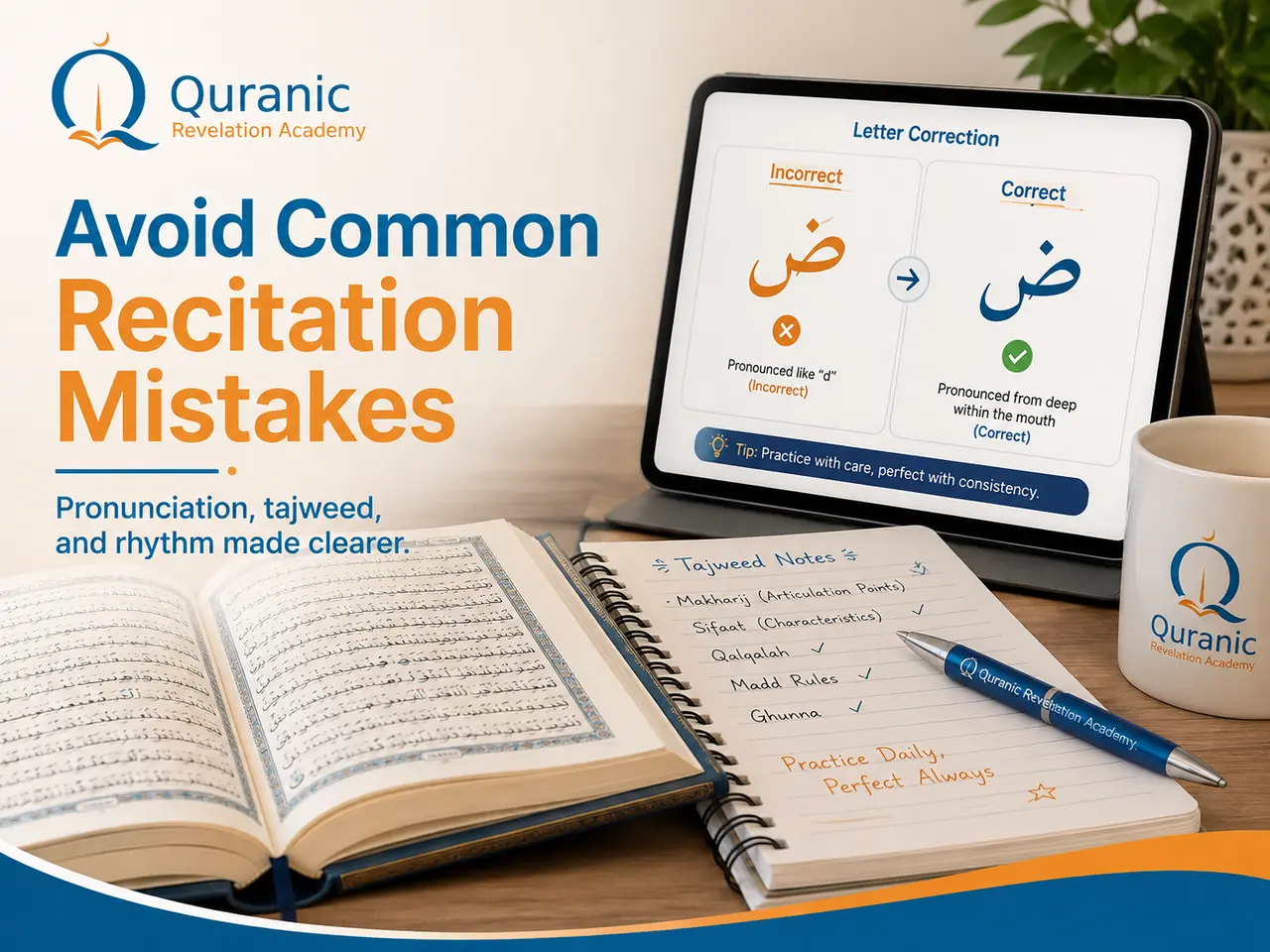
For many learners, the biggest recitation problem is not an advanced Tajweed rule. It is that two Arabic letters are being produced almost identically.
Pairs such as س and ص, ت and ط, ك and ق, ه and ح, or د and ض can be difficult depending on the learner’s first language.
The solution is to isolate the letter. Hear the contrast, practise it with short vowels, place it in a word and then return to the verse. Repeating the whole page without isolating the sound usually repeats the problem instead of fixing it.

Mistake two: short vowels are guessed or swallowed
A learner who reads too quickly may blur fathah, kasrah and dammah or overlook a sukoon and shaddah.
This can happen because the eyes are moving ahead of the mouth, or because a familiar-looking word is being guessed from memory.
Slow the word down. Point to each sign if necessary. Accuracy at a reduced speed is a better training environment than fluent guessing.
Dar al-Ifta — definition and ruling of Tajweed • Dr. Ayman Swaid — Tajweed resources • Tajweed — general reference
Mistake three: Tajweed is either ignored or exaggerated
After learning ghunnah, qalqalah or heavy letters, beginners sometimes make the new feature far stronger than necessary.
The opposite problem also occurs: reading with no audible difference at all.
Tajweed aims at accurate controlled pronunciation. A rule should be present in its correct measure. Listening to a competent model and then receiving correction is far more useful than trying to create the effect from a written definition alone.

Mistake four: speed hides weaknesses
Fast reading can feel impressive because the page moves quickly. It also gives the tongue less time to reach the correct articulation and gives the ear less time to notice what happened.
If the same errors keep returning, reduce the speed until you can control them.
Speed can grow later. A slower accurate reading is a stronger foundation than a fast reading whose mistakes are becoming automatic.

Mistake five: stopping wherever breath ends
Breath is physical, so an unexpected stop will sometimes happen. The important question is what you do next.
Stopping in an awkward place and restarting from the following word can separate parts of a phrase that belong together.
Learn the common stopping signs gradually and ask your teacher where to restart when you have to stop unexpectedly. Good recitation includes managing the verse as a meaningful phrase, not just individual sounds.

Mistake six: practising the error more than the correction
If you are uncertain about a word and repeat it twenty times alone, you may be strengthening the wrong version.
Use a shorter correction loop: hear the correct form, attempt it, receive feedback, repeat the corrected form and then return to it the next day.
Dr. Ayman Swaid’s official material on common recitation mistakes emphasizes exactly this kind of attention to errors that become widespread in recitation.
Turn mistakes into a personal correction list
A general statement like “my Tajweed needs work” is difficult to practise.
A list such as “ق becomes too close to ك”, “I lose shaddah when reading quickly”, and “madd length changes from word to word” is actionable.
Keep the list short. When one error becomes stable, replace it with the next most frequent problem.
A five-step correction method
- Record or read a short passage and identify one repeated error.
- Listen to the correct sound or rule from a reliable teacher.
- Practise only the difficult letter, word or phrase.
- Return the corrected form to the full verse.
- Test the same point again the following day.
- Keep the error on your correction list until it becomes stable.
Habits that make correction harder
- Reading faster whenever a difficult word appears.
- Repeating an uncertain pronunciation many times alone.
- Trying to fix ten errors at the same time.
- Memorizing Tajweed terminology without applying it.
- Ignoring stopping and restarting.
- Changing the pronunciation model constantly between many reciters.
Frequently asked questions
What is the most common Quran recitation mistake?
It varies by learner, but inaccurate articulation of similar Arabic letters and unstable vowels are frequent foundational problems.
Should I record my own recitation?
Yes, as a self-awareness tool. A recording can reveal hesitation and inconsistency, but teacher feedback remains useful for judging exact pronunciation.
Is reading slowly a bad habit?
No. Slow controlled reading is useful while correcting errors. Speed can increase after accuracy becomes more stable.
How many mistakes should I work on at once?
Usually a small number. Focusing on the most frequent two or three problems makes practice more deliberate.
Can Tajweed mistakes become permanent?
Long-standing habits can become automatic, but they can still be corrected through careful listening, feedback and repeated accurate practice.
Sources and further reading
Find the mistakes that matter most
A live teacher can hear your recitation and identify the recurring pronunciation and Tajweed points to practise first.