
Adult Quran Learning
Learning Quran as an Adult: A Practical Starting Guide
Starting Quran study as an adult is not a late start. Adults often bring clear goals, discipline and life experience, but they may also carry old pronunciation habits or embarrassment about beginning from the basics.
Start from your real level, accept slow foundational work when necessary, practise in short regular sessions, use live correction, and measure progress against your own previous reading rather than against someone who began years earlier.
Being an adult beginner is more common than it feels
Many adults assume that everyone else learned Quran reading properly as a child. In reality, adult learners arrive with very different histories. Some learned Arabic letters years ago and forgot them. Some can read familiar surahs but struggle with a new page. Others read reasonably well yet have never received systematic Tajweed correction.
The useful starting point is therefore not your age. It is your current skill.
Al-Azhar operates Quran programs specifically for adult learners and uses assessments to measure their level and progress. That is a helpful reminder that serious Quran learning does not belong only to childhood.

Do not let embarrassment choose your curriculum
An adult sometimes knows enough to hide weaknesses. You may recognize a word from memory and guess it rather than decode it, or rush through a difficult letter so the hesitation is less obvious.
That protects pride for a few seconds but slows learning for months.
If the foundation needs work, work on the foundation. Returning to letter articulation or short vowels is not moving backward. It is removing the exact obstacle that has been following you into every page.
Al-Azhar — Quran program for adult learners • Dar al-Ifta — regular Quran reading and understanding • Quran — general reference
Live correction is especially valuable for old habits
Pronunciation habits become automatic over time. A sound repeated incorrectly for twenty years may feel completely natural.
A live teacher can identify the precise difference between the sound you intend and the sound you actually produce. The correction may involve tongue position, airflow, lip movement or simply slowing the word down.
The point is not to make you self-conscious about every letter. It is to identify the small number of recurring errors that create most of the difficulty.
Build a routine around adult life, not an imaginary empty schedule
Work, family, commuting and changing responsibilities make rigid study plans difficult. This does not mean consistency is impossible.
A fifteen-minute routine that survives a busy week can be more valuable than a one-hour plan that happens only when life becomes unusually quiet.
Place Quran study beside something that already happens reliably: after a prayer, before breakfast, during a quiet lunch break or immediately before another established evening routine.
Separate reading, Tajweed, memorization and understanding
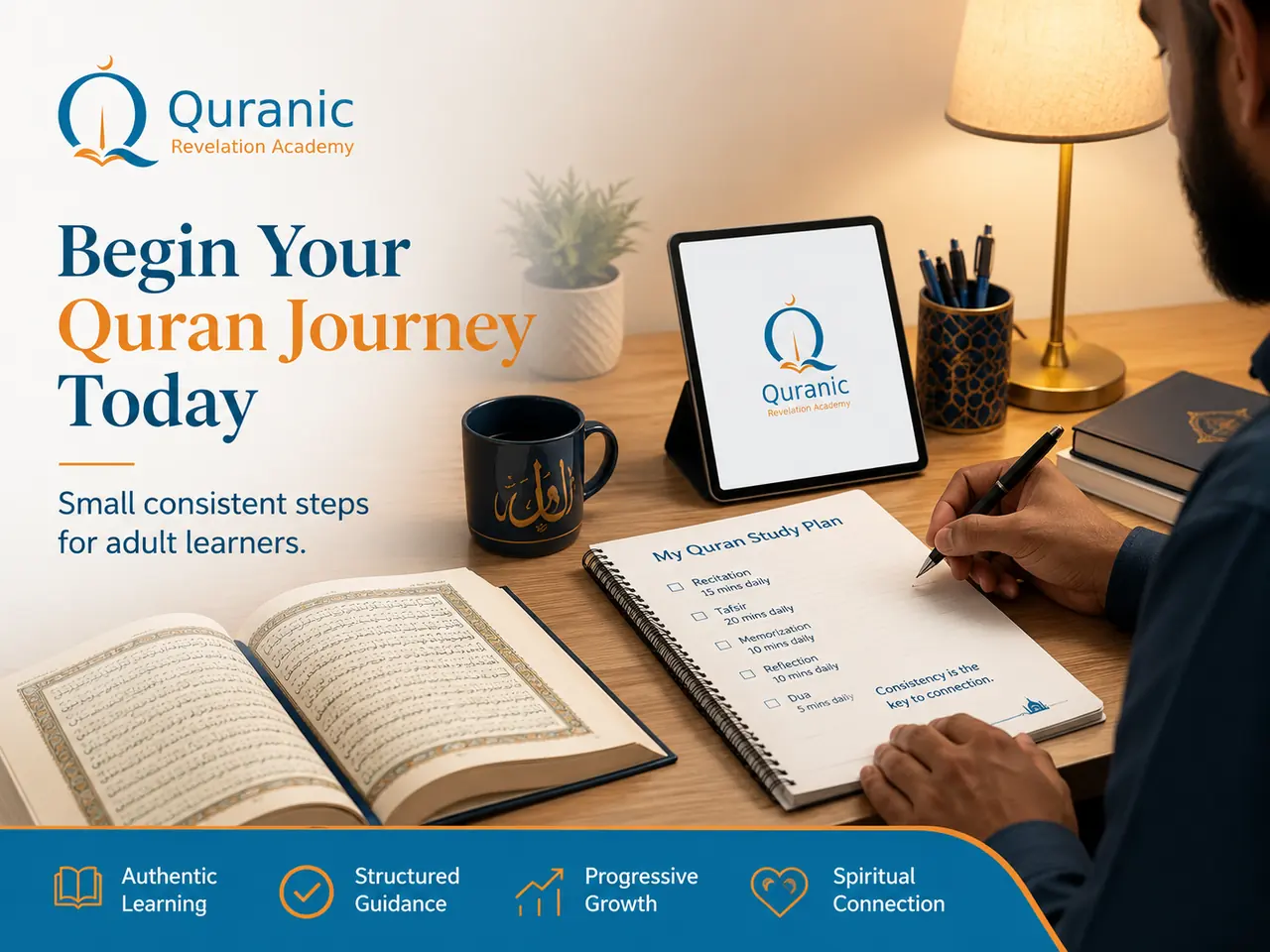
Adults often want to repair everything at once. That enthusiasm is useful, but too many simultaneous goals can make progress invisible.
Decide what the main goal of the current period is. Perhaps you are rebuilding reading fluency. Perhaps the reading is already stable and Tajweed is the priority. Perhaps you want Quranic Arabic alongside recitation.
Other goals do not disappear. They simply take a supporting role until the main weakness becomes stronger.

Use comparison carefully
Someone who began Quran study at five years old has thousands of hours of exposure you cannot reproduce in a few weeks. Comparing your first month with their twentieth year tells you almost nothing.
Compare instead with your own previous reading. Are unfamiliar words less intimidating? Are repeated mistakes becoming less frequent? Can you hear a mistake that you previously missed?
Those changes are real progress, even before speed changes dramatically.
The goal is a relationship that survives beyond the course
A course can give structure, but the deeper goal is that Quran remains part of ordinary life after the course ends.
Yaqeen Institute’s discussion on building a relationship with the Quran emphasizes starting with sustainable contact rather than waiting for perfect conditions.
For an adult learner, that may mean accepting a modest routine now and allowing it to grow naturally instead of designing a heroic plan that is impossible to maintain.
A realistic first month for an adult beginner
- Take a reading assessment and identify the two or three biggest weaknesses.
- Choose a minimum daily practice time that fits even busy days.
- Correct difficult letters before pushing for speed.
- Use each live lesson to obtain a short, specific practice assignment.
- Review previous corrections before adding new material.
- Record a short reading once a week to notice changes over time.
- Reassess after four weeks and change the plan according to actual progress.
Common mistakes adult learners make
- Pretending to be more advanced because the basics feel embarrassing.
- Trying to study reading, Hifz, Arabic and advanced Tajweed all at once.
- Creating a study schedule that does not fit normal working life.
- Comparing progress with lifelong readers.
- Practising pronunciation for long periods without correction.
- Stopping completely after one busy week.
Frequently asked questions
Is it too late to learn Quran properly as an adult?
No. Adults regularly begin or restart Quran study. The appropriate plan depends on the current reading level, not the age at which formal study began.
Should I restart from the Arabic alphabet?
Only if your assessment shows that letter recognition or basic decoding is still unstable. Otherwise you can begin from the specific weaknesses you actually have.
How much should a busy adult practise?
A small amount that happens consistently is more useful than a large target that repeatedly disappears. Even ten to fifteen focused minutes can support steady progress.
Can adults correct pronunciation habits learned years ago?
Yes, although established habits may take repeated listening and correction. Specific feedback and deliberate repetition are especially useful.
Should I memorize while improving my reading?
You can, but keep the amount manageable and make sure memorization does not reinforce pronunciation errors that are still being corrected.
Sources and further reading
Start from your real level
A live trial lesson can identify the reading and pronunciation points that matter most for you now.


Comments
2 responses to “Learning Quran as an Adult: A Practical Starting Guide”
[…] How to Learn Quran Online: A Practical Beginner’s Roadmap Quran Memorization Plan: Build a Sustainable Hifz Routine Learning Quran as an Adult: A Practical Starting Guide […]
[…] is why we built separate learning paths for children and adult Quran learners. The goal may be Quran learning in both cases, but the teaching approach should not be […]