
Choosing a Quran Teacher
How to Choose the Right Online Quran Teacher
A good Quran teacher is not simply someone who recites beautifully.
The right teacher should hear your mistakes, know how to correct them,
adapt the lesson to your level, and give you a clear path forward
without making the learning process unnecessarily complicated.
look for accurate Quran recitation and Tajweed, relevant teaching experience,
clear correction, patience, a structured learning plan, good communication
and a trial lesson where you can see how the teacher actually works with you.
Credentials matter, but teaching ability and student-teacher fit matter too.
Choosing an online Quran teacher can be surprisingly difficult.
Search for a few minutes and almost every profile sounds the same:
qualified, experienced, certified, patient, professional and flexible.
Those words are useful only when you can see what they mean in an actual lesson.
A teacher may have a beautiful recitation but struggle to explain why you keep
mispronouncing one letter. Another may know a large amount of theory but move
so quickly that a beginner spends the entire lesson trying to catch up.
The right question is therefore not:
“Who has the most impressive profile?”
A better question is:
“Who can identify what I need and help me improve it consistently?”

1. Start with the teacher’s Quran reading, not the website
The first requirement is obvious but important:
someone teaching Quran reading should themselves be able to recite accurately.
Egypt’s
Dar al-Ifta
states that the principle is that Quran reading should be taught
by someone who has mastered the rulings of recitation.
That does not mean you need to interrogate every teacher with a twenty-page exam.
But it does mean that “speaks Arabic” and “can teach Quran” are not identical claims.
Listen to the teacher recite.
Pay attention to the clarity of the letters,
the consistency of the Tajweed,
the pacing and whether the recitation sounds controlled rather than rushed.
If your goal is specifically
learning Tajweed,
the teacher should be able to explain the rules they are correcting,
not simply tell you to imitate them.
2. Ask what their qualification actually qualifies them to teach
You may see terms such as certificate, degree, sanad or
ijazah
in a teacher’s profile.
An ijazah is traditionally an authorization from a teacher
to transmit a particular text or area of knowledge,
usually connected to direct teacher-to-student study.
In Quran recitation, it can be a valuable indication
that the teacher’s own recitation has gone through a formal process.
But a credential should lead to another question:
what exactly is it in?
A qualification in Quran memorization is not necessarily
the same as qualification in a particular qira’ah,
Tajweed instruction,
Arabic language
or teaching young children.
The
Al-Azhar General Administration for Quran Affairs
describes Quran teachers as specialists in memorization and Tajweed,
while its supervisory system evaluates teachers
and links Quran teaching to appropriate educational
and specialist qualifications.
In another Al-Azhar recruitment notice,
candidates teaching Quran were required to demonstrate strong command
of Quran recitation and Tajweed,
pass oral testing
and complete specialist training.
The useful lesson for a student is simple:
credentials are worth checking,
but ask what they represent rather than collecting impressive titles.

3. Teaching skill is different from recitation skill
This is one of the easiest things to miss.
Someone can be an excellent reciter
and still find teaching difficult.
Teaching requires another set of skills:
watching how a student learns,
breaking a problem into small steps,
explaining the same idea in different ways
and knowing when to move forward.
A beginner who cannot distinguish two Arabic letters
does not need a five-minute lecture full of advanced terminology.
The student needs to hear the difference,
see how the sound is produced,
try it,
receive a correction
and try again.
Likewise, an advanced student should not spend month after month
repeating material they already control.
This idea of adapting teaching to the learner
is discussed beautifully in this Bayyinah video:
For your practical decision,
look for a teacher who changes pace when necessary.
If you struggle, they slow down.
If you understand quickly, they do not manufacture difficulty
just to fill the lesson time.
4. Watch how the teacher corrects mistakes
Correction tells you a great deal about teaching quality.
Imagine that you pronounce a letter incorrectly.
A weak correction may simply be:
“Wrong. Again.”
A useful correction sounds more like:
“This is the sound that changed.
Listen to the correct one.
Watch where the tongue is placed.
Now read only this word again.”
The difference is enormous.
The student should leave the correction understanding
what was wrong and what to do differently.
Al-Azhar’s Quranic training initiatives describe practical teacher development
that includes correct pronunciation,
the articulation points of letters
and their characteristics.
That practical emphasis matters because Quran reading is not learned
through definitions alone.
The teacher has to hear what actually comes out of the student’s mouth.
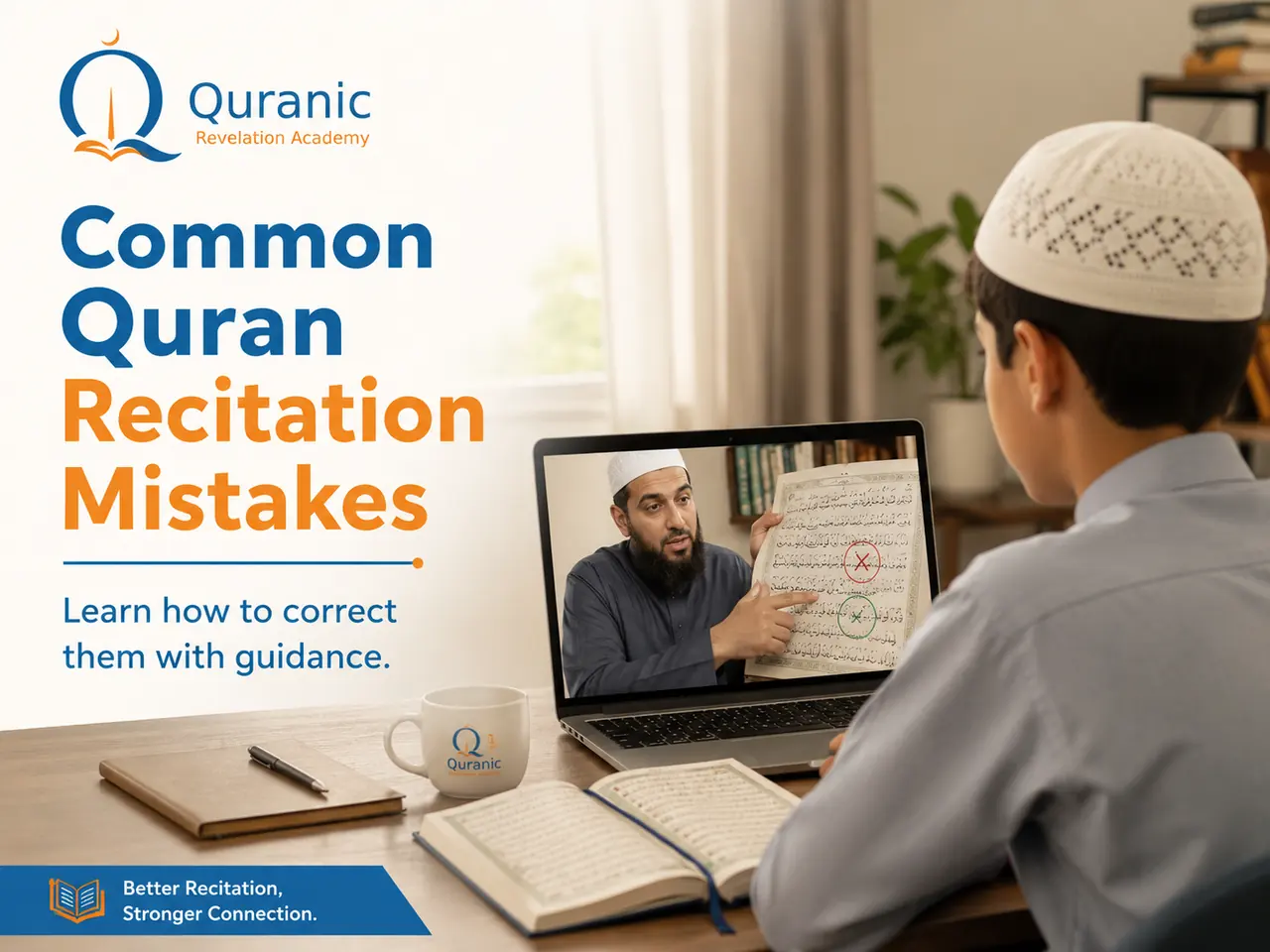
Our guide to
common Quran recitation mistakes
explains why repeated errors should be isolated and corrected
before they become automatic habits.

5. Ask whether they have taught students like you
Experience matters,
but the type of experience matters more than the number of years
written in a biography.
If you are a complete beginner,
ask whether the teacher regularly teaches people
who do not yet read Arabic.
If the student is six years old,
ask about experience teaching young children.
If you already recite confidently
and want advanced Tajweed correction,
ask whether the teacher works with students at that level.
If you are an adult returning to Quran after many years,
you may need a teacher comfortable correcting established habits
without treating you like a child.
That is why we built separate learning paths for
children
and
adult Quran learners.
The goal may be Quran learning in both cases,
but the teaching approach should not be identical.
6. Patience does not mean avoiding correction
A patient teacher is not someone who allows the same error
to continue forever because correction might feel uncomfortable.
Good patience means correcting without humiliating the student,
repeating an explanation when needed
and understanding that some sounds may take many attempts.
There is a useful balance here.
Too little correction and the student does not improve.
Too much interruption and the student never develops flow.
An experienced teacher learns when to stop immediately
and when to let the student finish a short phrase
before returning to the error.
7. Look for a visible learning plan
Ask the teacher:
“If I study with you for the next three months, what are we working toward?”
The answer does not need to be a rigid promise.
Learning speed varies too much for that.
But there should be some structure.
For example:
- assess current reading;
- correct the most important articulation problems;
- stabilize basic reading;
- introduce relevant Tajweed rules;
- review previous mistakes;
- measure whether the same errors are decreasing.
A lesson should not feel as if both teacher and student
are discovering the plan five seconds after the call begins.
You can see an example of a progressive beginner path in
our roadmap for learning Quran online
.

8. Use the trial lesson properly
A trial lesson is not only an opportunity to ask about price and schedule.
It is your best chance to observe the teaching itself.
Try to read something during the trial,
even if you are nervous.
Without hearing you,
the teacher cannot demonstrate much of their actual teaching ability.
Pay attention to five things:
- Does the teacher listen before deciding your level?
- Are corrections specific?
- Can you understand the explanation?
- Does the teacher adjust when you struggle?
- Do you leave knowing what you should practise next?
For a child,
a parent can also observe whether the teacher
keeps the learner engaged without turning every thirty seconds
into entertainment.
There should still be a real lesson taking place.
9. Do not choose only by price
Budget matters.
There is nothing wrong with comparing tuition costs.
But the cheapest lesson becomes expensive
if you spend a year reinforcing errors
and then need another teacher to rebuild your pronunciation.
At the same time,
a high price is not proof of high teaching quality.
Compare what is actually included:
lesson length,
one-to-one or group teaching,
teacher consistency,
feedback,
progress tracking,
rescheduling policies
and the teacher’s relevant expertise.
The useful metric is not simply price per hour.
It is whether those hours are producing meaningful progress.
10. For children, ask about safeguarding and parent communication
When the learner is a child,
there are additional questions beyond Tajweed.
Parents should know who is teaching,
how lessons are supervised,
how communication takes place
and who to contact if something needs to change.
For younger learners,
it can also be useful for a parent
to remain nearby during online sessions,
especially at the beginning.
The relationship should be professional,
clear
and transparent.
Read our
parent’s guide to online Quran classes for children
for a deeper look at this subject.
11. A good personality match matters
Not every excellent teacher is the right teacher for every student.
Some learners respond well to a very structured style.
Others need a calmer pace.
Some children become motivated by frequent encouragement,
while another student prefers brief correction
and more uninterrupted reading time.
This does not mean the teacher should simply tell the student
whatever they want to hear.
It means effective teaching happens inside a real human relationship.
The student should feel comfortable enough to make mistakes aloud,
while still respecting the seriousness of learning Quran.

Questions to ask before you commit
You do not need to ask all of these like an interview panel.
But the answers should become clear before you commit to a long program.
- What Quran or Tajweed training have you completed?
- Do you hold an ijazah, and if so, what is it specifically for?
- Do you regularly teach students at my level?
- How do you assess a new student’s reading?
- How do you track recurring mistakes?
- What should I practise between lessons?
- What happens if the teaching style is not a good fit?
- For children, how are parents kept informed about progress?
Red flags worth noticing
No one listens to you before placing you in a level
A course may have broad levels,
but Quran reading should eventually be assessed by actually hearing the student.
The teacher never explains corrections
Imitation has an important place in recitation,
but the learner should gradually understand
what keeps going wrong.
Every lesson looks exactly the same
A structured curriculum is good.
Ignoring the student’s actual needs is not.
Big promises about exact completion dates
Be cautious when someone guarantees
that every student will master Quran reading,
Tajweed or memorization in exactly the same number of weeks.
Learning depends on the starting level,
practice,
lesson frequency
and individual difficulty.
You are pressured into a long commitment before meeting the teacher
There is rarely a good educational reason
you should be unable to experience the teaching style
before making a significant commitment.
What should a good first month look like?
By the end of the first several weeks,
you should have more clarity than you had at the start.
You should know:
- your current reading level;
- the mistakes that occur most often;
- what you are practising between lessons;
- which Tajweed areas are being introduced;
- what the next learning milestone is.
You may not have transformed your recitation in four weeks.
That is not the point.
The important thing is that the journey is becoming less random.
Our article on
what happens during a live online Quran class
shows how assessment, correction and practice can fit together in a normal lesson.
Frequently asked questions
Does a Quran teacher have to be a native Arabic speaker?
No.
Native Arabic speech by itself does not prove mastery of Quran recitation
or teaching ability.
What matters is accurate recitation,
relevant knowledge,
good instruction
and the ability to correct the student’s reading.
Does every Quran teacher need an ijazah?
An ijazah can be a valuable credential,
especially for advanced recitation and transmission.
But students should still ask what the ijazah covers
and whether the teacher can actually teach their particular level effectively.
Should children have a different teacher from adults?
Not necessarily,
but the teacher should have experience with the relevant age group.
Teaching a six-year-old beginner requires different pacing
and communication from teaching an adult Tajweed student.
How many trial lessons should I take?
There is no required number.
Sometimes one lesson makes the fit very clear.
If you are uncertain,
trying another teacher can help you compare teaching styles
before committing.
What matters more: qualifications or experience?
Neither should completely replace the other.
Qualifications can demonstrate study and recitation standards.
Teaching experience shows whether that knowledge
can be communicated effectively to real students.
Sources and further reading
-
Egypt’s Dar al-Ifta — guidance on who should teach Quran reading
-
Al-Azhar — Quran Affairs educational services and Quran teacher standards
-
Al-Azhar — Quran teaching requirements, oral assessment and specialist training
-
Al-Azhar — Quranic recitation training, Tajweed and articulation development
-
Wikipedia — general background on the ijazah tradition
-
Bayyinah — Learning From the Greatest Teacher
Meet the teacher before you commit
Use a free trial lesson to let a teacher hear your current reading,
identify the areas that need attention
and see whether the teaching style works for you.


Comments
5 responses to “How to Choose the Right Online Quran Teacher”
[…] How to Choose the Right Online Quran Teacher How to Learn Quran Online: A Practical Beginner’s Roadmap Common Quran Recitation Mistakes and How to Fix Them […]
[…] to Learn Quran Online: A Practical Beginner’s Roadmap How to Choose the Right Online Quran Teacher How to Build a Consistent Daily Quran […]
[…] When choosing a tutor, look beyond a pleasant voice. Ask whether the teacher can explain mistakes clearly, adapt to your level and give you something specific to practise after class. You can also read our guide on how to choose an online Quran teacher. […]
[…] How to Choose the Right Online Quran Teacher Tajweed for Beginners: The Rules That Matter First Quran Memorization Plan: Build a Sustainable Hifz Routine […]
[…] for Beginners: The Rules That Matter First How to Choose the Right Online Quran Teacher What Happens in a Live Online Quran […]