
Quranic Arabic Roadmap
Learn Quranic Arabic: From Letters to Understanding
Learning Quranic Arabic is not about memorizing an enormous grammar book before understanding a single verse. A useful path connects reading, vocabulary and grammar directly to language you repeatedly meet in the Qur’an.
Build accurate Arabic reading first, learn high-frequency Quranic vocabulary, study basic sentence patterns and morphology in context, then deepen understanding through reliable tafsir rather than guessing meanings from vocabulary alone.
Quranic Arabic and everyday spoken Arabic are related, but not identical goals
A learner who wants to understand the Quran has a different immediate goal from someone preparing for everyday conversation in Cairo or Casablanca.
Both benefit from Arabic foundations, but Quranic study places special attention on Classical Arabic vocabulary, grammatical structures and the way words are used in revelation.
This does not make spoken Arabic useless. It simply means the study plan should reflect why you are learning the language in the first place.

Start with reading that no longer consumes all your attention
If every Arabic word still requires several seconds to identify each letter, grammar explanations quickly become exhausting.
You do not need perfect fluency before beginning vocabulary, but basic decoding should become sufficiently comfortable that your attention can begin shifting from “What letter is this?” to “What does this word mean here?”
Al-Azhar maintains dedicated programs and institutes for teaching Arabic to non-native speakers, reflecting the fact that second-language learners need structured language teaching rather than simply being placed in native-level material.
Al-Azhar — Arabic for non-native speakers • Classical Arabic background • Quran general reference
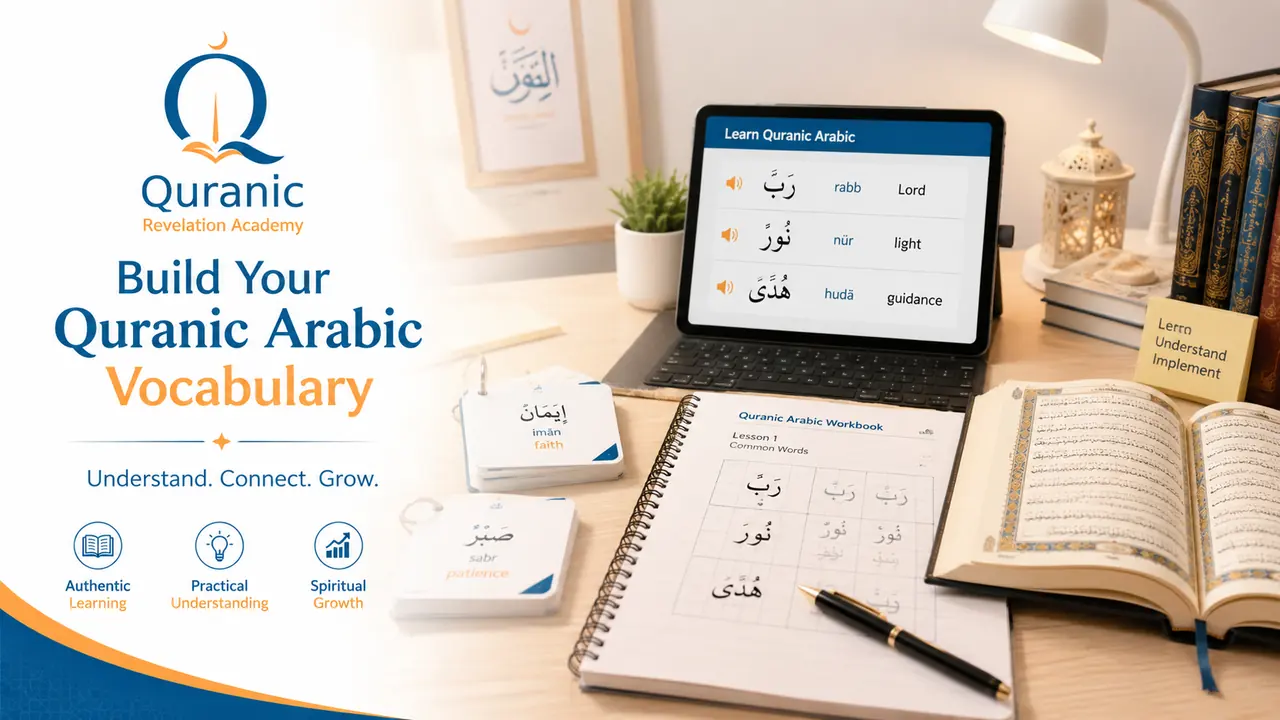
Build vocabulary from words you actually meet repeatedly
A random vocabulary list may teach useful Arabic, but Quranic vocabulary study becomes more motivating when words repeatedly reappear in the text you are reading.
Learn a modest number of words, then notice them in different verses. Pay attention to how a familiar root can appear in several forms.
Do not expect one English translation to capture every use of an Arabic word. Vocabulary gives you access to the sentence, but context and interpretation still matter.

Learn enough grammar to see relationships inside the verse
Grammar becomes useful when it answers real questions: Who is performing the action? What is being described? Which noun belongs to another noun? Why did the ending of this word change?
Begin with broad categories such as nouns, verbs and particles, then simple nominal and verbal sentences, pronouns, adjective relationships and common prepositions.
Later, morphology helps you recognize families of related forms. The purpose is not collecting labels. It is seeing more of the structure that was previously invisible.

Do not turn vocabulary knowledge into personal tafsir
Understanding more Arabic can transform the experience of reading the Quran, but knowing a root or grammatical pattern does not automatically settle the interpretation of a verse.
Words operate inside context, rhetoric and a wider scholarly tradition. Use Arabic knowledge to read more intelligently, then consult reliable tafsir for explanation rather than assuming the first dictionary meaning must be the intended meaning.
Language study should increase humility and precision, not produce greater confidence in guesses.

Use the Quran itself as a recurring practice environment
After learning a grammatical pattern or a group of words, return to a short surah and look for them. This turns abstract study into recognition.
A verified Bayyinah discussion on learning Arabic for Quranic understanding emphasizes a sustained journey rather than expecting instant access to the language.
Regular exposure matters. Twenty minutes several times a week usually creates a stronger connection than studying intensely once and then forgetting the material for a month.
Measure comprehension in layers
At first, success may simply mean recognizing ten words in a familiar surah. Later you begin identifying sentence structure. Later still, you notice why a particular form or word order matters.
Do not dismiss the early layers because they feel small. Language knowledge compounds.
The goal is not to stop using translation or tafsir as quickly as possible. The goal is to understand more of the Arabic while using scholarly tools more intelligently.
A practical beginner sequence
- Stabilize Arabic letters, vowels and joined reading.
- Learn a small set of high-frequency Quranic words.
- Study basic nouns, verbs and particles.
- Learn simple nominal and verbal sentence patterns.
- Introduce common pronouns, prepositions and adjective structures.
- Begin basic morphology and word families.
- Apply every new concept to verses you already read.
- Use reliable tafsir when moving from language to interpretation.
Common mistakes when learning Quranic Arabic
- Trying to master all grammar before reading real text.
- Memorizing isolated vocabulary without revisiting it in verses.
- Assuming one dictionary gloss explains every Quranic use of a word.
- Jumping into interpretation beyond what the language study actually proves.
- Ignoring reading fluency while focusing entirely on grammar.
- Studying irregularly in very large bursts.
Frequently asked questions
Do I need to speak Arabic fluently to understand Quranic Arabic?
No. Quranic comprehension and everyday conversational fluency overlap, but they are not identical goals. You can study Quran-focused vocabulary and grammar without first becoming a fluent speaker.
Should I learn grammar or vocabulary first?
A small amount of both works well. Vocabulary lets you recognize content, while basic grammar shows how the words relate to one another.
How many words should I memorize?
Start with a manageable group of high-frequency words and revisit them repeatedly in Quranic context instead of chasing a very large list.
Can Arabic replace tafsir?
No. Arabic knowledge helps you understand the text more directly, but tafsir addresses context, interpretation and scholarly explanation beyond vocabulary and grammar alone.
How long does Quranic Arabic take to learn?
There is no single deadline. Reading background, study frequency and the depth of understanding you want all change the timeline.
Sources and further reading
Start Quranic Arabic at the right level
A trial lesson can identify whether your next step should be Arabic reading, vocabulary, grammar or a combination of these skills.