
Sustainable Hifz Guide
Quran Memorization Plan: Build a Sustainable Hifz Routine
A memorization plan works only if revision survives after the excitement of learning new pages fades. Sustainable Hifz is built around realistic new material, strong review and a routine that can continue on ordinary days.
Choose a small daily amount, memorize accurately, review older material every day, recite regularly to a teacher and increase the target only when previous memorization remains stable.
Hifz is not only a system for adding new verses
The most exciting part of memorization is usually the new portion. It gives a visible feeling of progress: another half-page, another surah, another milestone.
But the real test of a memorization system is what happens to material learned three weeks or six months ago. If new pages keep arriving while old pages quietly disappear, the plan is producing collection rather than preservation.
A sustainable Hifz routine therefore treats revision as part of memorization itself, not as an optional activity saved for the future.

Choose a target you can repeat on an ordinary day
A target is useful only when it fits the learner’s real schedule and current ability. One student may maintain half a page a day, while another needs several days for the same amount.
The correct amount is not the largest amount you can memorize once. It is the amount you can learn accurately while still protecting yesterday’s and last month’s work.
Al-Azhar’s Quran memorization initiatives repeatedly combine memorization with review and mastery. That pairing is important: the goal is not merely reaching the end of a page, but keeping it.
Al-Azhar Quran memorization and review initiative • Yaqeen — building a daily relationship with Quran • Quran general reference
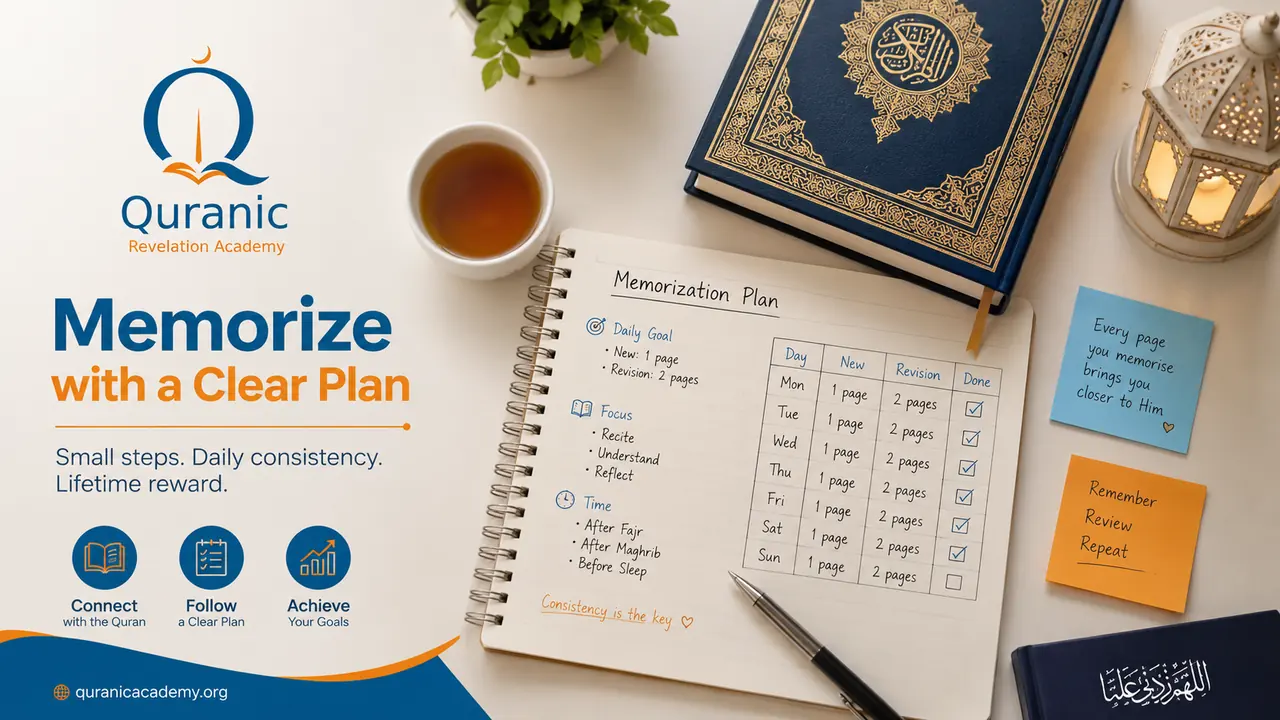
Memorize cleanly before increasing quantity
If the new passage contains unstable pronunciation or repeated hesitation, adding more material creates a larger revision problem tomorrow.
Read the passage correctly first. Divide it into manageable phrases, listen carefully, repeat without rushing and connect the phrases only after the smaller sections become stable.
A teacher can also stop mistakes before they become attached to the memorized wording. Correcting an error after hundreds of repetitions can be far harder than correcting it on the first day.

Separate new memorization from recent and older review
Many learners benefit from thinking in three layers: today’s new portion, recent material from the last days or weeks, and older memorization that needs periodic circulation.
These layers do not have to be equal in size. In fact, as the memorized amount grows, review often needs more time than new memorization.
If an older section becomes weak, reducing the new target temporarily is not failure. It is maintenance of the foundation that allows future memorization to remain useful.

Use listening as support, not as a substitute for recall
Listening to a skilled reciter can help establish pronunciation, rhythm and the sequence of verses. It is especially useful before memorizing a difficult passage.
But recognition is easier than recall. A verse may feel familiar while the recitation is playing and disappear when the audio stops.
Turn the recording off regularly and test yourself from memory. Recite from the beginning of the passage, start from the middle and ask a teacher or partner to prompt you from unexpected points.

Consistency matters more than heroic bursts
A very ambitious weekend followed by five empty days is difficult to build on. Memorization benefits from frequent retrieval because the material is repeatedly brought back into active memory.
The daily amount can be small. The important part is that the relationship with the memorized material continues.
A Yaqeen Institute discussion on building a relationship with the Quran makes a similar practical point about integrating Quran into normal life rather than waiting for an ideal schedule. For Hifz, that principle is especially valuable.
Let weakness change the plan before it becomes a crisis
If yesterday’s portion is repeatedly collapsing, do not keep increasing the new assignment simply because the schedule says so.
Pause, reduce or temporarily stop new memorization and repair the weak section. A flexible plan is often more sustainable than a rigid plan that looks impressive on paper.
The best long-term target is not the fastest possible completion date. It is reaching the next stage with enough stability that the earlier Quran remains available to you.
A practical 30-day Hifz structure
- Choose a modest daily new portion for the first week.
- Review yesterday’s material before starting anything new.
- Create a separate block for older memorization.
- Recite to a teacher regularly and record repeated mistakes.
- At the end of each week, test the entire week without looking.
- Reduce new material when previous portions become unstable.
- Increase the target only after the routine feels comfortably sustainable.
Common memorization mistakes
- Making the new portion much larger than the revision capacity.
- Memorizing before the pronunciation is stable.
- Listening repeatedly without testing independent recall.
- Reviewing only the most recently memorized pages.
- Refusing to reduce the target when older memorization becomes weak.
- Comparing completion speed with another student.
Frequently asked questions
How much Quran should I memorize each day?
There is no universal amount. Choose a portion you can memorize accurately while still reviewing recent and older material.
Should I memorize every day?
Daily contact is useful, but not every day needs new material. Some days may be devoted entirely to review.
What should I do when old memorization becomes weak?
Reduce or pause new memorization temporarily and rebuild the weak sections through repeated recall and correction.
Is listening enough for memorization?
Listening supports pronunciation and familiarity, but strong memorization requires recalling the passage without the recording.
Do I need a teacher for Hifz?
A teacher is especially helpful for correcting recitation, checking accuracy and identifying mistakes that the learner may not notice independently.
Sources and further reading
Build a Hifz plan around your actual level
A live teacher can check your current memorization and recitation, then help you choose a realistic balance between new material and review.